AI estimate as of December 1, 2025 · verify with a professional before acting
AI-Generated · Verify before acting
Everything on this page is generated by AI for informational purposes only. AI can make mistakes — the AI may misidentify items or misattribute them (artist, maker, brand, designer, origin, era). This is not an official valuation and should not be used for insurance, sale, tax, estate, legal, or lending purposes — or any decision requiring a certified appraisal. It is not an authoritative claim about any person, brand, or rights holder — do not share or rely on it as a factual statement about a third party. Always consult qualified professionals before making financial decisions.
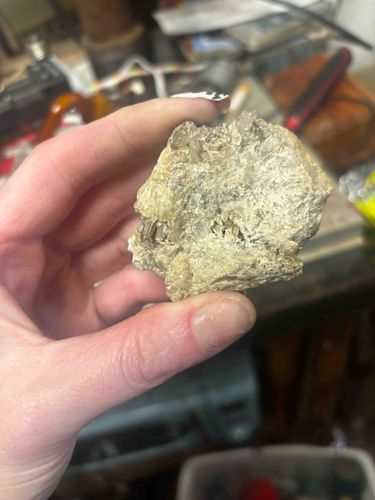
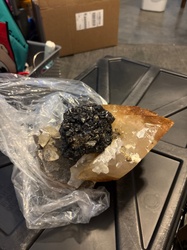
The item is a small, irregular specimen composed primarily of a light tan to off-white matrix rock with several small, semi-transparent to opaque crystal formations embedded within and on its surface. The matrix appears to be a sandy or sedimentary rock, exhibiting a somewhat porous and textured surface. The overall dimensions are difficult to ascertain precisely without a scale, but it appears to be approximately 3-5 centimeters in its longest dimension, held comfortably between a person's thumb and forefinger. The crystals themselves are most likely quartz, given their common occurrence and visible characteristics. They are generally colorless to very light brown or gray, with some exhibiting a slightly milky or cloudy appearance, indicating either impurities or microcrystalline structure. Some crystal faces are moderately well-formed, showing typical hexagonal prism shapes, while others are more fractured or indistinctly terminated. A notable feature is the presence of several small, shiny metallic inclusions or mineral specks, potentially pyrite or another sulfide mineral, adding a subtle sparkle. The specimen shows natural raw edges, consistent with a mineral dug directly from the earth, rather than a polished or cut piece. There are no discernible man-made markings, signatures, or stamps. Its condition appears natural for a rough mineral specimen, with no visible damage from handling or processing, though some natural fracturing is present. The estimated age is geological, as are all natural mineral formations. This piece represents a natural mineral specimen, likely collected for its aesthetic appeal as a raw crystal formation.
AI Appraisal Report
Upon visual examination of the provided image, I assess this Quartz Crystal Cluster on Matrix as a natural geological specimen. The crystals exhibit characteristics consistent with quartz, showing typical hexagonal forms on some faces, and variable translucency from colorless to milky. The matrix appears to be a sedimentary rock, likely sandstone, which is common for such formations. I see no evidence of artificial enhancement or manipulation; the specimen’s raw edges and natural fracturing indicate an authentic, unadulterated mineral sample directly from the earth. The small metallic inclusions, potentially pyrite, add a minor aesthetic interest without significantly altering composition or rarity. Based on the description, the piece is small (3-5 cm), which places it within the 'thumbnail' or 'miniature' specimen category.
In terms of market conditions, small, common quartz clusters on matrix are readily available from numerous sources including mineral shows, online retailers, and rock shops. Comparables for specimens of this size, quality, and mineral type typically range from $10 to $75, depending heavily on crystal clarity, perfection of form, and the aesthetics of the matrix. This particular specimen's limited crystal clarity, small size, and relatively common form suggest it falls on the lower to mid-range of this spectrum. Demand for such pieces is generally steady among hobbyists and beginner collectors, but the rarity is low, as quartz is one of Earth's most abundant minerals.
Factors impacting value positively are the natural crystal forms and the contrasting matrix; negatively, its small size, limited optical clarity, and lack of exceptionally well-formed or rare crystals. Limitations in authenticity verification from an image alone include the inability to physically assess crystal habit, hardness, specific gravity, or respond to chemical tests, which would be crucial for definitively confirming mineral identity if there were any doubt. Without physical inspection, provenance documentation, or scientific testing, precise identification of the matrix and metallic inclusions remains presumptive based on common associations. However, for common minerals like quartz, visual cues are often sufficient for general appraisal purposes. Overall, this is a charming, yet relatively common, natural mineral formation.