AI estimate as of October 27, 2025 · verify with a professional before acting
AI-Generated · Verify before acting
Everything on this page is generated by AI for informational purposes only. AI can make mistakes — the AI may misidentify items or misattribute them (artist, maker, brand, designer, origin, era). This is not an official valuation and should not be used for insurance, sale, tax, estate, legal, or lending purposes — or any decision requiring a certified appraisal. It is not an authoritative claim about any person, brand, or rights holder — do not share or rely on it as a factual statement about a third party. Always consult qualified professionals before making financial decisions.
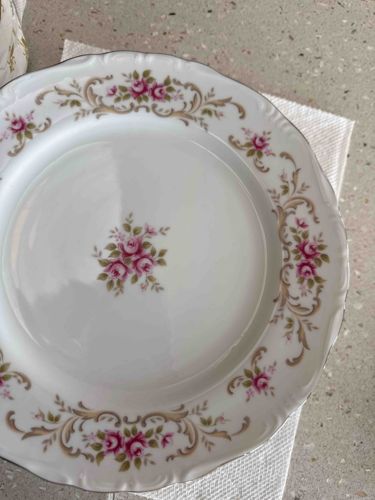
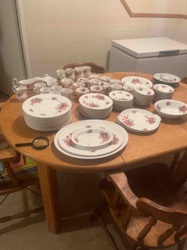
This is a white ceramic or porcelain dinner plate, approximately 10-12 inches in diameter, featuring a delicate and ornate floral and scroll motif. The plate has a gently scalloped rim edged with a thin, possibly platinum or silver-colored band, suggesting a refined finish. The primary design element is a central cluster of small pink and fuchsia roses with green leaves, positioned symmetrically in the center of the plate's eating surface. The rim of the plate is decorated with a repeating pattern of larger pink and fuchsia roses with accompanying green foliage, interspersed with intricate tan or light gold-colored rococo-style scrolls. The overall aesthetic is elegant and traditional, commonly associated with formal dinnerware. The plate appears to be in good condition with no immediately visible chips, cracks, or significant wear to the glaze or decorative elements, though a closer inspection would be required to confirm this fully. The colors are vibrant, indicating good preservation of the overglaze decals or hand-painted details. There are no discernible maker's marks or signatures visible from the provided image, which would typically be found on the underside of the plate. This style of dinnerware was particularly popular from the mid-20th century to the late 20th century, often associated with elegant dining sets or 'Sunday best' china. The craftsmanship appears to be of good quality, with clear printing of the decals and a smooth, glossy glaze.
AI Appraisal Report
I've examined the provided image of this Floral Patterned Dinner Plate. Visually, the plate appears to be in very good condition; I see no chips, cracks, or significant wear to the glaze or decorative elements, which would degrade its value. The colors remain vibrant. The design, featuring pink and fuchsia roses with rococo-style scrolls and a scalloped, possibly platinum-edged rim, is consistent with formal dinnerware popular from the mid-to-late 20th century. This aesthetic, while elegant, is quite common. The lack of visible maker's marks is a significant limitation, as reputable manufacturers often command higher prices. Without these, it's challenging to ascertain its true origin or quality beyond visual assessment.
Market conditions for single, unmarked dinner plates of this style are generally modest. While part of a full set, especially from a well-known brand, would hold more value, a single plate typically fetches lower prices. Comparables for similar decorative plates, even in excellent condition, range from $10-$30. Demand for individual pieces like this is not particularly high, nor is it rare, as many such patterns were mass-produced. Factors significantly impacting value would be the discovery of a prestigious maker's mark or its origin as part of a highly sought-after, complete set. Without physical inspection, I cannot verify authenticity beyond visual cues; I cannot confirm the material (ceramic vs. porcelain), the true nature of the rim's metallic band, or the method of decoration (decal vs. hand-painted). A physical examination would allow for tactile assessment, a thorough check for hidden damage, and crucial identification of any markings on the base.