AI estimate as of November 11, 2025 · verify with a professional before acting
AI-Generated · Verify before acting
Everything on this page is generated by AI for informational purposes only. AI can make mistakes — the AI may misidentify items or misattribute them (artist, maker, brand, designer, origin, era). This is not an official valuation and should not be used for insurance, sale, tax, estate, legal, or lending purposes — or any decision requiring a certified appraisal. It is not an authoritative claim about any person, brand, or rights holder — do not share or rely on it as a factual statement about a third party. Always consult qualified professionals before making financial decisions.
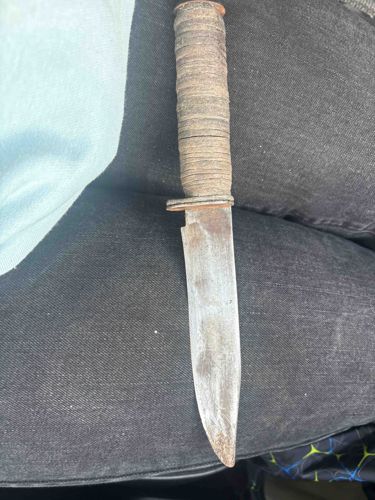
This is a vintage fixed-blade knife featuring a distinctive stacked leather handle and a carbon steel blade. The handle construction is characterized by multiple stacked leather washers, which are worn and darkened with age, indicating significant use and providing a tactile grip. The pommel appears to be a smaller, possibly peened, metal end cap that has also developed a dark patination. A simple metal guard separates the handle from the blade, also exhibiting a dark, possibly rust-covered, finish consistent with age. The blade itself is a drop-point or clip-point style, made of what appears to be carbon steel due to its dull, oxidized, and heavily patinated surface. There are significant signs of wear, pitting, and surface rust across the entire blade, suggesting prolonged exposure to moisture and lack of maintenance. The blade shows evidence of repeated sharpening, maintaining a functional edge but with visible grinding marks and nicks. The tip of the blade, while still intact, is dull and shows signs of localized corrosion. The overall condition suggests a utility or field knife that has seen extensive service over many years. There are no visible maker's marks or stamps in the provided image, precluding identification of the manufacturer or specific model. Based on the material choices and construction, it likely dates from the mid-20th century, possibly earlier, as this style of stacked leather handle was popular for military and hunting knives during that period. The craftsmanship appears robust, designed for practical use rather than decorative appeal, but the current condition shows significant material degradation.
AI Appraisal Report
This vintage fixed-blade knife, featuring a stacked leather handle and carbon steel blade, presents as a well-used utility item from the mid-20th century. Its authenticity as an aged, functional knife of that era appears consistent with the visual evidence provided. The stacked leather handle, while showing significant wear, darkening, and age-related patination, is characteristic of military or hunting knives from the period. The carbon steel blade exhibits substantial pitting, surface rust, and wear, indicative of extensive use and exposure, along with multiple sharpening cycles. The absence of maker's marks, while common for some utilitarian knives, limits specific identification and thus impacts value.
Market conditions for unmarked, heavily used vintage utility knives are generally modest. While stacked leather handled knives have a collector base, the poor condition of the blade (pitting, rust, wear) and the lack of maker identification significantly depress its collectible value. Comparables would include other generic vintage hunting or utility knives in similar condition. Demand is relatively low due to the condition and anonymity. Rarity is not a significant factor here; stacked leather handles were common.
Factors significantly impacting value negatively are the extensive corrosion, the lack of any discernible maker's mark, and the overall heavily worn condition. Enhancing factors are limited to its age and the tactile appeal of its worn, functional aesthetic.
Based on the visual examination, I estimate an appraisal value of $50-$100. For full authentication, particularly if specific provenance or maker identification were claimed, an in-person examination would be critical to check for hidden marks, assess blade grind consistency, and perform metallurgical analysis if required. Documentation of ownership history would also be invaluable, but is not present here.