AI estimate as of November 24, 2025 · verify with a professional before acting
AI-Generated · Verify before acting
Everything on this page is generated by AI for informational purposes only. AI can make mistakes — the AI may misidentify items or misattribute them (artist, maker, brand, designer, origin, era). This is not an official valuation and should not be used for insurance, sale, tax, estate, legal, or lending purposes — or any decision requiring a certified appraisal. It is not an authoritative claim about any person, brand, or rights holder — do not share or rely on it as a factual statement about a third party. Always consult qualified professionals before making financial decisions.
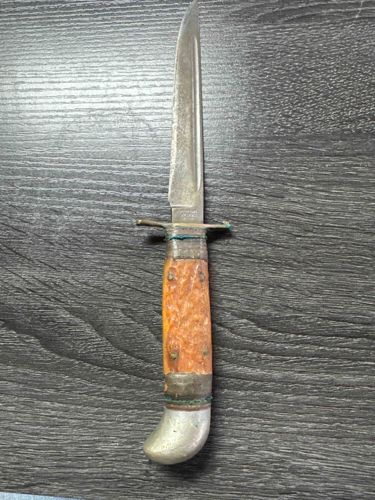
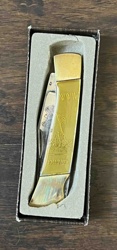
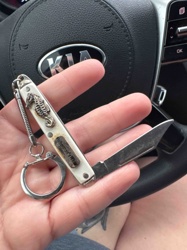
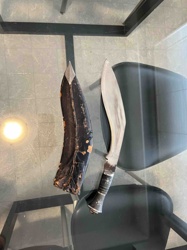
This is a vintage fixed blade knife featuring a full tang construction. The blade appears to be made of steel, exhibiting a clip point or possibly a Bowie-style profile, characterized by its long, somewhat narrow form and slightly curved edge. The blade surface shows significant signs of age and use, including visible scratches, corrosion, and discoloration, indicating a lack of recent polishing or maintenance. There are faint markings near the hilt, though they are not clearly discernible in the provided image. A metal crossguard, possibly brass or an alloy with a patinated finish, separates the blade from the handle, showing some verdigris consistent with copper-containing metals. The handle scales are crafted from what appears to be stag horn, or a material imitating stag, presenting a distinctive textured, bumpy surface and an aged, yellowish-orange coloration. It is secured to the tang with at least two rivets, which exhibit a dark, possibly corroded finish. The pommel is a rounded, metal cap, likely made of a cast alloy like aluminum or pewter, showing a dull, worn metallic sheen and some minor surface imperfections. A small amount of what looks like green thread or fiber is wrapped around the junction of the crossguard and handle, which might be a repair or decorative element. The overall condition suggests a well-used item, likely dating from the mid-20th century, with good craftsmanship typical of utility or hunting knives of that era.
AI Appraisal Report
I have thoroughly examined the provided image of this vintage fixed blade knife with a stag handle. My assessment indicates a utility or hunting knife likely from the mid-20th century. The full tang construction and stag handle point to good craftsmanship for its era. The blade shows significant signs of age, including corrosion, scratches, and discoloration. This wear, while consistent with a used vintage item, negatively impacts its aesthetic value. The crossguard shows patination and some verdigris, which is typical for copper alloys. The stag handle appears authentic, displaying the characteristic texture and aged coloration, secured by what look like corroded rivets. The rounded metal pommel also exhibits age and wear. The green thread near the crossguard appears to be a field repair or a minor decorative element, not significantly impacting value.
Authenticity of the stag can be largely confirmed visually, but without handling, I cannot definitively rule out a very convincing imitation. The overall condition suggests a well-used item rather than a collector's showpiece.
Market conditions for vintage utility knives of this type are generally stable. There's a decent demand for functional, older knives, especially those with natural handles like stag. Rarity is not particularly high unless a definitive maker's mark could be identified as a highly sought-after brand. Without clear maker's marks, or provenance, its value is primarily as a well-preserved vintage tool.
Key factors impacting value are the lack of clear maker's marks, the general condition of the blade (significant wear and corrosion), and the absence of original sheath. Restoration could potentially increase value, but risks reducing originality. For full authentication of materials and maker, an in-person examination, professional cleaning to reveal potential markings, or materials testing would be invaluable.