AI estimate as of September 4, 2025 · verify with a professional before acting
AI-Generated · Verify before acting
Everything on this page is generated by AI for informational purposes only. AI can make mistakes — the AI may misidentify items or misattribute them (artist, maker, brand, designer, origin, era). This is not an official valuation and should not be used for insurance, sale, tax, estate, legal, or lending purposes — or any decision requiring a certified appraisal. It is not an authoritative claim about any person, brand, or rights holder — do not share or rely on it as a factual statement about a third party. Always consult qualified professionals before making financial decisions.
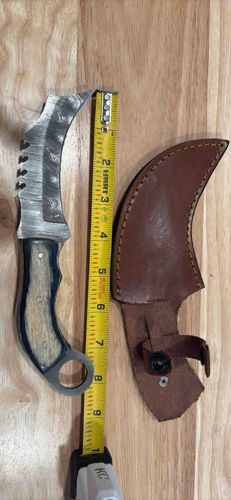
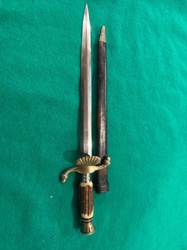
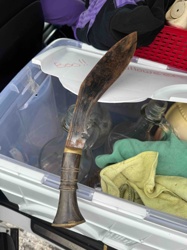
This item is a custom-made karambit-style knife, crafted from what appears to be Damascus steel, characterized by its distinctive wavy patterns on the blade. The overall length of the knife, as indicated by the measuring tape, is approximately 8.5 inches. The blade itself is curved, typical of a karambit, and features a prominent serrated edge along the spine, followed by a series of cut-out finger grooves on the top edge of the blade, transitioning into the handle. The blade exhibits a visible hammered or textured finish, adding to its artisanal appearance. The handle is constructed with two contrasting wood or micarta scales, secured to the full tang with three visible silver-toned pins. The handle scales have a lighter, natural wood tone on the inner section, bordered by a darker blue-gray material, creating a two-tone effect. The ergonomic shape of the handle includes finger grooves for a secure grip. At the pommel end of the handle, there is a large, integrated finger ring, a characteristic feature of karambit knives, which appears to be made from the same steel as the tang. The knife comes with a custom-fitted, dark brown leather sheath. The sheath is hand-stitched with lighter brown thread along its edges, and features a flap with a metal snap closure designed to secure the knife's handle. The leather shows some slight creasing and marks consistent with handling and light use. No specific maker's marks or signatures are discernible on the knife or sheath. Given the Damascus steel and custom appearance, it likely dates from the late 20th to early 21st century, possibly a handcrafted piece.
AI Appraisal Report
Based on my visual examination of the provided image, this custom-made karambit knife, featuring a Damascus steel blade and a bespoke leather sheath, appears to be in very good condition. The Damascus steel pattern is discernible, and the blade exhibits a clean, well-defined form, characteristic of a custom piece. The handle, with its two-tone scales and ergonomic finger grooves, appears well-crafted and securely attached. The accompanying leather sheath is custom-fitted and shows only minor signs of handling, consistent with light use or careful storage. Authenticity, based purely on imagery, points towards a genuine custom-made item rather than mass-produced. The Damascus steel appears legitimate, but without physical examination, confirmation of layering technique or material purity is impossible.
Several factors influence its value. As a custom-made Damascus steel karambit, it holds appeal for collectors of unique knives and those appreciating handmade craftsmanship. Karambits generally maintain a strong niche market, and the inclusion of Damascus steel elevates its desirability. The serrated spine and cut-out features are less common, adding to its custom appeal. However, the absence of a discernible maker's mark or signature significantly impacts its top-tier collectible value, as provenance is key for high-end custom knives. While custom-made, it lacks the verifiable artisan name that would command higher prices.
In terms of market comparables, similar unmarked custom Damascus karambits from individual makers or small shops typically range from $150 to $350, depending on the quality of the Damascus, the handle materials, and overall finish. This piece falls well within that range, leaning towards the higher end due to its clear craftsmanship and the well-executed two-tone handle and custom sheath.
To fully authenticate and ascertain the complete value, an in-person examination would be crucial. This would allow for a precise assessment of the Damascus steel's quality (e.g., number of layers, weld integrity), the blade's edge retention, and the overall fit and finish. Microscopic analysis could confirm the steel type. Additionally, any provenance documentation, such as a bill of sale from the maker or a certificate of authenticity, would substantially increase its verifiable value and reduce authentication limitations.