AI estimate as of October 2, 2025 · verify with a professional before acting
AI-Generated · Verify before acting
Everything on this page is generated by AI for informational purposes only. AI can make mistakes — the AI may misidentify items or misattribute them (artist, maker, brand, designer, origin, era). This is not an official valuation and should not be used for insurance, sale, tax, estate, legal, or lending purposes — or any decision requiring a certified appraisal. It is not an authoritative claim about any person, brand, or rights holder — do not share or rely on it as a factual statement about a third party. Always consult qualified professionals before making financial decisions.
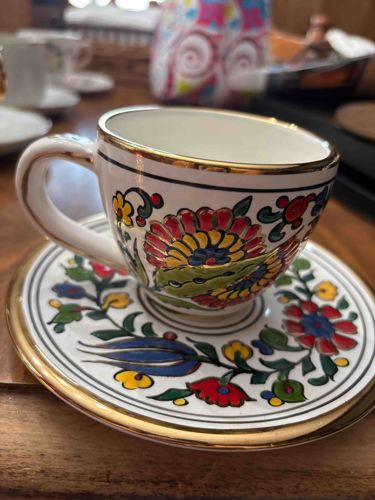
This is a charming hand-painted ceramic coffee cup and saucer set, likely originating from Turkey, designed for serving Turkish coffee. The set features a vibrant and intricate floral pattern, characteristic of traditional Iznik or Kutahya style pottery. Both the cup and saucer are predominantly white or cream-colored, providing a neutral canvas for the colorful decoration. The cup has a classic, sturdy form with a C-shaped handle, and both pieces are adorned with a lustrous gold trim around their rims and along the cup's handle, suggesting a touch of elegance and craftsmanship. The detailed floral motifs on both pieces utilize a rich palette of red, blue, green, and yellow, with black outlines defining the shapes of flowers, leaves, and swirling vine-like elements. Notable features include a large central red and yellow flower on the cup and a distinctive blue tulip-like motif on the saucer, surrounded by smaller blossoms and foliage. The painting appears hand-executed, evidenced by slight variations in line work and color application, contributing to its unique character. The overall condition appears excellent, with no visible chips, cracks, or significant wear to the paint or gold trim. The glossy glaze finish enhances the vibrancy of the colors. The craftsmanship suggests a modern souvenir or artisanal piece, possibly from the late 20th or early 21st century, designed to evoke historical Anatolian pottery styles. The quality of the hand-painting is high, showing careful attention to detail in the intricate designs.
AI Appraisal Report
This charming hand-painted Turkish coffee cup and saucer set, likely a modern souvenir or artisanal piece, immediately presents itself with excellent condition upon visual inspection. The vibrant floral pattern, reminiscent of traditional Iznik or Kutahya styles, shows no visible chips, cracks, or significant wear to the paint or elegant gold trim. The glossy glaze enhances the rich palette of red, blue, green, and yellow, with crisp black outlines. The hand-executed nature of the painting, with its subtle variations, adds to its unique character.
Based on current market conditions for similar contemporary artisanal or souvenir Turkish ceramic sets, I estimate the value to be in the range of $40-$70. Comparables include new hand-painted sets sold in tourist markets or specialty stores, which typically fetch prices in this range, sometimes higher for exceptionally detailed or larger pieces. While the craftsmanship is high, contemporary pieces, even well-executed ones, do not command the same value as antique or historically significant Iznik/Kutahya pottery.
Demand for such decorative and functional items is generally steady, driven by both collectors of global ceramics and individuals seeking unique home decor or gift items. Rarity is not a significant factor here, as these styles are still produced extensively.
It is important to note the limitations of a visual examination. While the piece presents as contemporary artisanal, without in-person inspection, it is impossible to confirm the exact age, origin, and specific ceramic body used. Examination for artist signatures, maker's marks, or specific firing techniques would require physical access. Provenance documentation could also provide valuable information regarding its history and exact origin, which could influence value, although for a piece of this type, it is less common to have extensive documentation.