AI estimate as of August 31, 2025 · verify with a professional before acting
AI-Generated · Verify before acting
Everything on this page is generated by AI for informational purposes only. AI can make mistakes — the AI may misidentify items or misattribute them (artist, maker, brand, designer, origin, era). This is not an official valuation and should not be used for insurance, sale, tax, estate, legal, or lending purposes — or any decision requiring a certified appraisal. It is not an authoritative claim about any person, brand, or rights holder — do not share or rely on it as a factual statement about a third party. Always consult qualified professionals before making financial decisions.
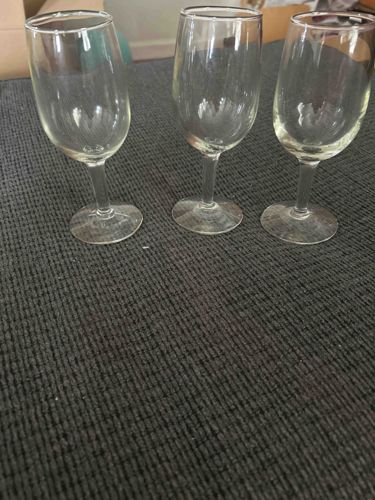
This lot consists of three clear glass stemware pieces, likely intended as wine or water glasses. Each glass features a classic goblet-style bowl, a slender stem, and a round, flat foot. They appear to be uniformly sized, standing approximately 7-8 inches tall, though exact dimensions cannot be determined from the image. The material is clear, uncolored glass, exhibiting some minor surface dust and potentially water spots, suggesting they have been used or stored for some time. There are no obvious chips, cracks, or significant damage visible, although a closer inspection would be required to confirm their pristine condition. The rims are smooth, and the bowls are relatively standard in shape, neither extremely narrow nor excessively wide, indicative of a versatile utility. The craftsmanship appears to be functional and mass-produced, lacking intricate details or unique artistry that would suggest handmade or high-end designer origins. No maker's marks, signatures, or specific manufacturing details are discernible from the provided images. Based on their simple, unadorned design, these glasses likely date from the mid-20th century to contemporary times, possibly from the last 20-40 years, typical of household or restaurant glassware. Their quality is practical, suitable for everyday use rather than collectible value.
AI Appraisal Report
I have examined the provided image of this clear glass stemware set of three. Visually, the glasses appear to be in good used condition, with no obvious chips or cracks visible from the photograph. Minor surface dust and water spots are present, indicating typical use or storage. The design is simple and unadorned, suggesting mass production rather than artisanal craftsmanship. I note the lack of any maker's marks or distinguishing features, which is common for utilitarian glassware.
In terms of authenticity, based solely on the image, these appear to be genuine clear glass stemware pieces. However, without a physical inspection, I cannot verify the exact material composition, detect hairline cracks or subtle fleabites, or assess the precise quality of the glass itself. An in-person examination would allow for a tactile assessment of the rim smoothness, stem stability, and overall structural integrity. Provenance documentation, while unlikely for such common items, would confirm ownership history.
The market for common, unbranded clear glass stemware is robust, characterized by high supply and moderate demand for everyday use. Comparables include new sets from department stores or pre-owned sets sold at thrift stores, garage sales, and online marketplaces. Given their generic nature and lack of unique features, rarity is not a factor. Demand is driven by practical utility rather than collector interest. Factors significantly impacting value are primarily condition and quantity; a full, matching set in pristine condition would command a slightly higher price per unit. However, as a set of three, they are somewhat incomplete, further limiting their appeal.
Considering the ubiquity of similar items and their functional, rather than aesthetic or historical, value, I appraise this set conservatively. This appraisal is limited by the visual-only examination; a full authentication would require physical inspection to confirm the absence of subtle flaws and assess overall quality.