AI estimate as of October 4, 2025 · verify with a professional before acting
AI-Generated · Verify before acting
Everything on this page is generated by AI for informational purposes only. AI can make mistakes — the AI may misidentify items or misattribute them (artist, maker, brand, designer, origin, era). This is not an official valuation and should not be used for insurance, sale, tax, estate, legal, or lending purposes — or any decision requiring a certified appraisal. It is not an authoritative claim about any person, brand, or rights holder — do not share or rely on it as a factual statement about a third party. Always consult qualified professionals before making financial decisions.
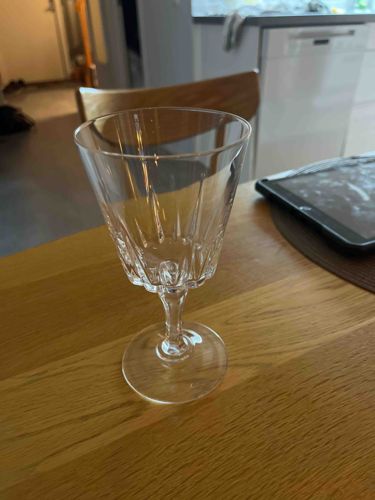
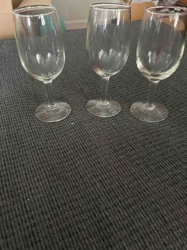
This is a clear, cut crystal drinking glass, likely intended for water or wine. It exhibits classic faceted cutting, with vertical flutes or panels extending upwards from the base of the bowl, transitioning into a simpler, smooth rim. The glass measures approximately 6-8 inches in height, judging by its proportion to the visible tabletop. Its construction comprises three main parts: a footed base, a slender stem, and a bowl. The foot is flat and circular, providing stability. The stem is relatively short and thick, connecting the foot to the bowl without any elaborate knots or decorations. The bowl itself has a slightly flared rim and tapers down towards the stem. The cutting pattern on the bowl is intricate, featuring multiple sharp-edged facets that reflect light, indicating good quality lead crystal or a high-quality glass with similar light-refracting properties. There are no visible chips, cracks, or significant abrasions on the surface, suggesting good to excellent condition with minimal wear. Without a maker's mark or signature, a precise manufacturing date is difficult to ascertain, but the style suggests a mid-20th century to contemporary period. The craftsmanship appears to be of good standard, with clean cuts and a well-formed shape, indicating either machine-made precision or skilled hand-cutting. This type of glassware is commonly found in formal dining sets or for special occasions.
AI Appraisal Report
I have examined the provided image of this clear, cut crystal drinking glass, likely intended for water or wine. Visually, the condition appears to be excellent; I observe no chips, cracks, or significant abrasions. This suggests careful handling or recent acquisition. The classic faceted cutting, with vertical flutes transitioning to a smooth rim, is well-executed, indicating either high-quality machine precision or skilled handmanship. The slender stem and stable foot are characteristic of well-designed stemware.
Authenticity: Based solely on the image, I can confirm the item is a cut-crystal style drinking glass. However, confirming if it is true lead crystal versus high-quality soda-lime glass or its precise manufacturer is impossible without physical inspection. Lead crystal typically possesses a higher refractive index and a distinct 'ring' when flicked, which cannot be assessed remotely. Without a maker's mark, typical for many glassware pieces, identifying the exact origin or pattern is also not feasible from an image.
Demand and Rarity: This style of cut glass is classic and remains in moderate demand for formal dining or decorative purposes. However, it is not particularly rare, as many manufacturers produced similar designs from the mid-20th century onwards. Comparable items from reputable crystal manufacturers like Waterford, Baccarat, or Orrefors (if definitively identified) would command higher prices. Without such identification, this piece falls into the category of good-quality generic cut crystal stemware.
Factors impacting value: The excellent condition is a positive factor. However, the lack of a discernible maker's mark or definitive identification of lead crystal and manufacturer significantly limits its individual value. This type of glassware is often more valuable as part of a complete set rather than as a single piece.
For full authentication and a more precise valuation, I would require a physical examination to test for lead content, assess the 'ring' and clarity, and search for any subtle, potentially obscured maker's marks or pattern identifiers. Provenance documentation (e.g., original receipts, appraisal documents) would also be beneficial if available.