AI Appraisal Estimate

AI-generated estimates · not official valuations

From the user

What was submitted

Photo and notes provided by the user — not generated by AI

Submitted item photo
Submitted photo · June 18, 2026

User's notes

No additional notes provided.

AI analysis below

AI appraisal

AI analysis & estimate

AI-Generated · Verify before acting

Everything below is generated by AI for informational purposes only. AI can make mistakes — the AI may misidentify items or misattribute them (artist, maker, brand, designer, origin, era). This is not an official valuation and should not be used for insurance, sale, tax, estate, legal, or lending purposes — or any decision requiring a certified appraisal. It is not an authoritative claim about any person, brand, or rights holder — do not share or rely on it as a factual statement about a third party. Always consult qualified professionals before making financial decisions.

Read the full disclaimer

AI Identification

·Not independently authenticated·Verify before acting

Vintage Hammered Copper or Metal Pitcher/Ewer

Antique and Vintage Metalware

AI Estimated Value

·Not an official valuation·Verify before acting

$125 - $225

As of June 18, 2026

AI Item Analysis

·AI can make mistakes·Verify before acting
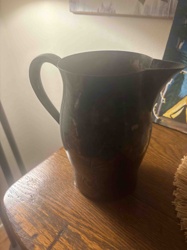
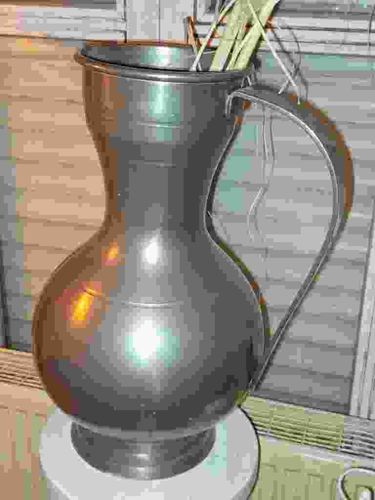
This item is a large, hand-forged metal pitcher or ewer, likely constructed from copper or a similar heavy-duty metal with an aged patina. It features a distinct baluster-style silhouette, characterized by a bulbous, rounded lower body that sits upon a flared circular pedestal base. The body tapers into a long, slender neck before widening again into a flared, rimmed mouth. A prominent, large strap handle is securely attached from the upper rim to the mid-section, forming a graceful, high-arched curve that extends well beyond the profile of the vessel. The construction appears to be traditional, with visible horizontal banding or seams around the neck and the widest part of the belly, suggesting a multi-piece assembly common in mid-20th-century metalwork or traditional folk crafts. The external surface exhibits a deep, darkened finish with noticeable reflections, indicating a possible aged copper or blackened metallic coating. There are signs of age-related wear, including minor surface abrasions and a dulling of the finish, which contributes to its vintage character. While no explicit maker's marks are visible in the provided image, the utilitarian yet decorative design suggests a production period between the late 19th and mid-20th centuries. It is currently being used as a decorative container for plant life, showcasing its functionality as both a vessel and an ornamental piece.
AI Appraisal Report

·AI can make mistakes·Verify before acting
Based on my visual examination of this oversized hammered copper ewer, I have determined it to be a fine example of mid-20th-century artisanal metalware, likely originating from Mediterranean or Middle Eastern copper-smithing traditions. The vessel exhibits a classic baluster form with a hand-riveted strap handle and a flared pedestal base. The visible horizontal seams and hammer marks indicate traditional cold-working techniques rather than modern industrial stamping. The condition appears fair to good for its age. The deep, oxidized patina is consistent with long-term exposure and minimal polishing, which is often preferred by collectors of 'rustic' or 'farmhouse' aesthetics. I noted some minor surface abrasions and potential lime scaling consistent with its current use as a planter; however, no significant structural denting or metal fatigue was observed in the primary silhouette. Market demand for large-scale copper decorative arts remains steady, particularly for interior design 'statement pieces.' Comparables found at specialty antique auctions for similar utilitarian ewers (approx. 18-24 inches) typically realize between $150 and $250. The lack of a visible maker's mark or specific provenance limits the valuation to its decorative utility rather than historical significance. Limitations of this appraisal: This assessment is based solely on digital images. To fully authenticate the age and material composition, a physical inspection is required to check for 'tinning' on the interior (indicating food-grade use), weight-to-volume ratio, and the presence of any stamped hallmarks on the base. Scientific testing or provenance documentation would be necessary to confirm if this predates the 20th century.

Get your items appraised

Instant estimates of your treasures with AI-powered appraisals

Browse More Appraisals