AI estimate as of October 30, 2025 · verify with a professional before acting
AI-Generated · Verify before acting
Everything on this page is generated by AI for informational purposes only. AI can make mistakes — the AI may misidentify items or misattribute them (artist, maker, brand, designer, origin, era). This is not an official valuation and should not be used for insurance, sale, tax, estate, legal, or lending purposes — or any decision requiring a certified appraisal. It is not an authoritative claim about any person, brand, or rights holder — do not share or rely on it as a factual statement about a third party. Always consult qualified professionals before making financial decisions.
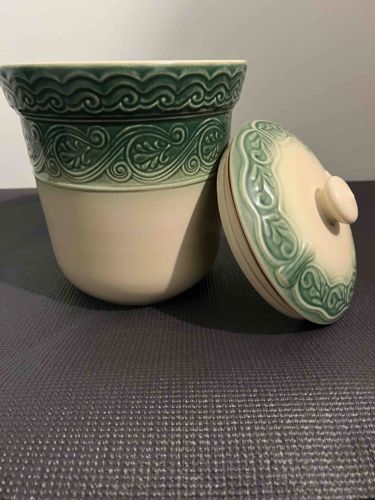
This item is a cylindrical ceramic canister, approximately 6-8 inches in height and similar in diameter, crafted from what appears to be glazed earthenware or stoneware. The body of the canister features a two-tone design; the lower two-thirds are a smooth, matte cream or off-white color, while the upper third, including the rim, is a glossy dark green. The dark green section is elaborately embossed with decorative patterns. The topmost band displays a wavy or scalloped relief, beneath which a wider band showcases a repeating botanical or foliate motif, characterized by swirling leaves and tendrils. Below this, a narrower band of continuous S-scrolls or interconnected waves completes the green decorated area. The separate, domed lid mirrors the aesthetic of the canister, predominantly off-white with a matching dark green embossed border featuring a similar, though slightly simplified, foliate pattern around its edge. A small, round, off-white knob serves as the handle on the lid. The craftsmanship appears to be of good quality, with clear, crisp embossing and consistent color application. No obvious chips, cracks, or significant wear are visible from the provided images, suggesting it is in good condition. The style hints at a traditional or perhaps even a rustic aesthetic, possibly dating from the mid-20th century to contemporary production, without explicit maker's marks visible. The item could function as a storage jar for kitchen goods, collectibles, or decorative purposes.
AI Appraisal Report
I have visually examined this Embossed Ceramic Canister with Lid based on the provided images. The item appears to be in good condition, showing no obvious chips, cracks, or significant wear. The craftsmanship, with clear embossing and consistent color application, suggests good manufacturing quality. The two-tone, embossed design points to a mid-20th century to contemporary production, likely intended for decorative storage. The materials appear to be glazed earthenware or stoneware.
Market comparables for similar mass-produced ceramic canisters in good condition typically range from $20 to $60, depending on design appeal, specific manufacturer (if known), and condition. This item's decorative embossing and two-tone aesthetic contribute positively to its visual appeal, placing it in the mid-to-upper end of this range for general storage ware. There is no indication of rarity; such items were frequently produced for the domestic market. Demand is steady for functional and aesthetically pleasing kitchen or decorative storage items, but not exceptionally high for unbranded pieces.
Factors impacting value include its good condition and attractive design. However, the lack of maker's marks, specific historical provenance, or artistic significance limits its potential as a collectible, keeping it firmly in the decorative utilitarian category. Its value is primarily driven by its aesthetic and functional utility.
A significant limitation in this appraisal is the verification of authenticity and precise age from images alone. Without an in-person examination, I cannot confirm the exact ceramic body, assess for hairline cracks or minor chips not visible in photographs, or search for any faint maker's marks that might be present but uncaptured. Provenance documentation, if available, could establish a precise manufacturing date or origin, which would enhance its value if linked to a significant producer or artist. Scientific testing would be excessive for an item of this type but would confirm material composition if genuinely needed.