AI Appraisal Estimate

AI-generated estimates · not official valuations

From the user

What was submitted

Photo and notes provided by the user — not generated by AI

Submitted item photo
Submitted photo · June 4, 2026

User's notes

No additional notes provided.

AI analysis below

AI appraisal

AI analysis & estimate

AI-Generated · Verify before acting

Everything below is generated by AI for informational purposes only. AI can make mistakes — the AI may misidentify items or misattribute them (artist, maker, brand, designer, origin, era). This is not an official valuation and should not be used for insurance, sale, tax, estate, legal, or lending purposes — or any decision requiring a certified appraisal. It is not an authoritative claim about any person, brand, or rights holder — do not share or rely on it as a factual statement about a third party. Always consult qualified professionals before making financial decisions.

Read the full disclaimer

AI Identification

·Not independently authenticated·Verify before acting

Caucasian Style Flatweave Kilim Runner

Textiles and Floor Coverings

AI Estimated Value

·Not an official valuation·Verify before acting

$850 - $1,200

As of June 4, 2026

AI Item Analysis

·AI can make mistakes·Verify before acting
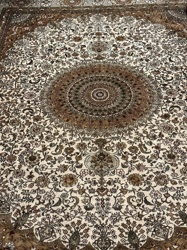
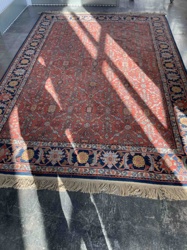
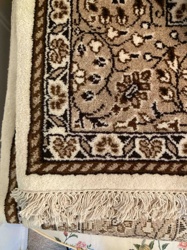
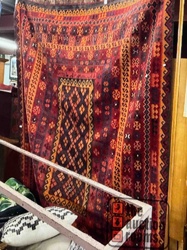
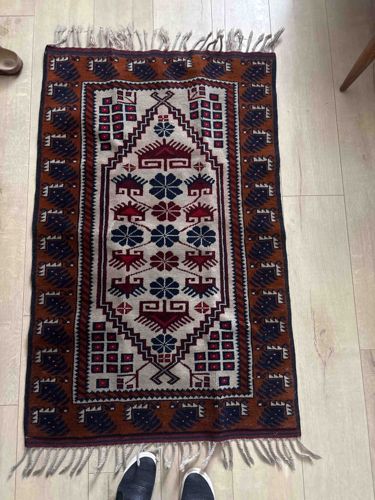
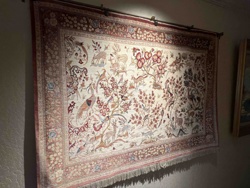
This is a rectangular hand-woven flatweave rug, commonly known as a Kilim, featuring a prominent geometric design characteristic of Caucasian or Anatolian tribal weaving traditions. The rug is composed of wool, with visible undyed or light-grey wool fringe at both ends. The color palette includes a rich rust-red or terracotta background in the main border, contrasted with a cream-white central medallion field. The secondary design elements are executed in navy blue and deep crimson. Centrally, it showcases a stacked series of geometric floral rosettes encapsulated within a large, stepped diamond medallion. The border contains a repeating 'leaf and wine' or 'serrated leaf' motif. Construction appears to be a slit-weave technique, giving the rug a flat, reversible profile. Regarding condition, the rug shows signs of gentle use; the fringe is somewhat uneven but intact, and there is slight rippling along the selvedge, which is common for handmade tribal textiles. No significant staining or moth damage is immediately visible, though there is a slight patina consistent with mid-20th-century age. The craftsmanship displays high-quality hand-spinning of the wool, evidenced by slight variations in dye saturation (abrash), particularly in the rust tones.
AI Appraisal Report

·AI can make mistakes·Verify before acting
I have examined the provided image of this Caucasian-style kilim runner. Based on the slit-weave construction, the presence of 'abrash' color variations in the rust dyes, and the specific 'leaf and wine' border motifs, I attribute this piece to a mid-20th-century tribal origin, likely from the Shirvan or Karabakh regions of the Caucasus. The use of hand-spun wool and traditional geometric rosettes indicates a high level of craftsmanship. The condition appears to be very good; while some selvedge rippling and fringe wear are present, these are consistent with authentic handmade textiles of this age and do not significantly detract from the value. The market for Caucasian flatweaves remains stable, with runners being particularly desirable for modern interior design applications. Comparable pieces of this size and color density typically realize between $800 and $1,300 at specialized auction houses or through reputable dealers. The cream-white central field is a value-add, as it is rarer than the fully saturated red fields commonly found in these regions. However, a definitive valuation is limited by the digital nature of this inspection. Because I cannot physically handle the rug, I cannot confirm the presence of synthetic dyes or evaluate the 'handle' (flexibility and weight) of the weave. Full authentication would require a tactile examination of the reverse side to verify the tension of the weft and an inspection for hidden repairs or structural dry rot. Provenance documentation or a chemical analysis of the dyes would be required to rule out contemporary 'reproduction' kilims produced in Turkey or India using similar historical patterns.

Get your items appraised

Instant estimates of your treasures with AI-powered appraisals

Browse More Appraisals