AI estimate as of December 9, 2025 · verify with a professional before acting
AI-Generated · Verify before acting
Everything on this page is generated by AI for informational purposes only. AI can make mistakes — the AI may misidentify items or misattribute them (artist, maker, brand, designer, origin, era). This is not an official valuation and should not be used for insurance, sale, tax, estate, legal, or lending purposes — or any decision requiring a certified appraisal. It is not an authoritative claim about any person, brand, or rights holder — do not share or rely on it as a factual statement about a third party. Always consult qualified professionals before making financial decisions.
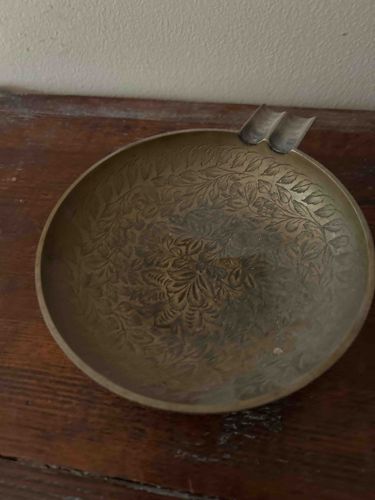
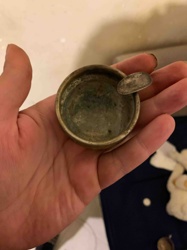
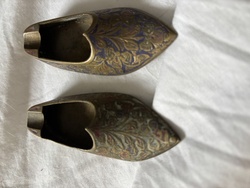
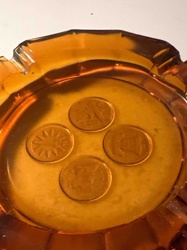
This is a vintage circular ashtray, seemingly crafted from brass or a similar copper alloy, given its distinct golden-brown hue and the visible signs of natural patination. The item features a shallow, bowl-like form with a gently curved rim. Its most striking characteristic is the intricate, hand-engraved floral or foliate pattern that covers the entire interior surface of the bowl. The engraving depicts a dense arrangement of leaves and perhaps small blossoms, executed with fine lines, suggesting a traditional artisanal technique. At one section of the rim, there are two distinct, slightly raised indentations or rests, designed to hold cigarettes or cigars. These rests show a somewhat lighter, more polished brass color compared to the bowl's deeper patina, possibly indicating more frequent handling or wear in those areas. The overall condition shows considerable age and use, with a dark, uneven patina distributed across the surface, especially within the engraved recesses, which enhances the contrast of the design. There are no obvious signs of major damage such as dents or cracks, but general surface wear and some minor scratches are visible, consistent with typical use over many years. The craftsmanship appears to be of good quality, with the engravings showing a consistent depth and detail. Given its material and decorative style, it likely dates from the mid-20th century or earlier, possibly originating from parts of Asia or the Middle East where such brassware is common. The precise manufacturing details like maker's marks are not visible in the provided image.
AI Appraisal Report
I have visually examined this vintage circular brass ashtray. Its golden-brown hue and visible patination strongly suggest a copper alloy, likely brass. The condition is consistent with considerable age and use, exhibiting a dark, uneven patina, especially within the finely executed hand-engraved floral/foliate pattern. Surface wear and minor scratches are present, but no significant damage like dents or cracks are visible. The two cigarette rests show lighter wear, indicative of frequent handling. The craftsmanship appears good, with consistent engraving depth. Authenticity, based solely on visual cues, suggests it is indeed a vintage piece from the mid-20th century or earlier, potentially from regions known for such brassware. The patina appears natural and undisturbed.
In terms of market conditions, vintage brass ashtrays generally occupy a niche market. Comparables for similar engraved brassware often fetch modest prices unless associated with a well-known maker or significant historical provenance. Demand for such utilitarian vintage items is moderate, primarily driven by collectors of antique brass or those seeking decorative accessories with a traditional aesthetic. Rarity for a piece of this type and craftsmanship is not exceptionally high, as mass production of similar items was common in its likely era of origin. The lack of visible maker's marks or specific identifying features limits its unique appeal and thus its value.
Factors significantly impacting its value include the genuine age, the intact and detailed engraving, and the absence of major damage. However, the lack of definitive provenance, the absence of a maker's mark, and its common utilitarian nature cap its upper value. Without physical inspection, I cannot confirm the exact metal composition, manufacturing technique (e.g., hand-hammered vs. cast base), or precise age. For full authentication and a more precise valuation, an in-person examination would be critical to assess metallurgy, weight, and the precise nature of the engraving and patina. XRF analysis could confirm the alloy, and a detailed stylistic analysis might pinpoint a more specific region of origin. Currently, based on images alone, its authenticity as a vintage engraved brass item seems plausible.