AI estimate as of August 24, 2025 · verify with a professional before acting
AI-Generated · Verify before acting
Everything on this page is generated by AI for informational purposes only. AI can make mistakes — the AI may misidentify items or misattribute them (artist, maker, brand, designer, origin, era). This is not an official valuation and should not be used for insurance, sale, tax, estate, legal, or lending purposes — or any decision requiring a certified appraisal. It is not an authoritative claim about any person, brand, or rights holder — do not share or rely on it as a factual statement about a third party. Always consult qualified professionals before making financial decisions.
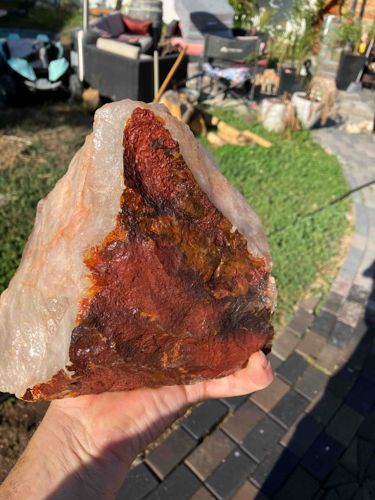
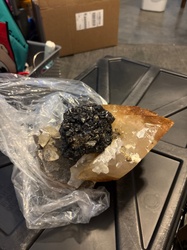
This item is a large, unpolished natural mineral specimen, likely a quartz formation with prominent iron staining. Its physical characteristics reveal a substantial, irregular shape, consistent with a raw geological find, and it appears to be held in an adult's hand, indicating a size roughly comparable to a large melon or small boulder. The primary material is a translucent to opaque quartz, exhibiting a milky white or light gray hue, visible along the top and left sides of the specimen. Nestled within this quartz matrix, and forming a significant portion of the piece, is a vibrant section of rich reddish-brown to dark orange coloration. This reddish area displays a rough, somewhat textured surface, suggesting the presence of iron oxides or other mineral inclusions that have oxidized, creating the distinct pigmentation. There are no discernible manufacturing details, such as maker's marks, signatures, or stamps, which is typical for a raw mineral specimen. The condition appears natural and unworked, with no visible signs of repair or artificial alteration. The surface texture varies between the smoother, more crystalline quartz and the coarser, more granular iron-stained areas. The item's age is geological, dating back millions of years to its formation, while its 'found' or 'collected' age is indeterminate but recent given its pristine natural state. Its unique aspect lies in the dramatic contrast between the clear/white quartz and the intensely colored, likely iron-rich, inclusion. The craftsmanship is entirely natural, showcasing the inherent beauty and geological processes of mineral formation.
AI Appraisal Report
Based on my visual examination of the provided image, this Quartz Specimen with Iron Staining appears to be an authentic, unworked natural mineral specimen. The irregular shape, varied translucency of the quartz, and the distinct reddish-brown iron staining are consistent with geological formations. Its size, significant enough to be held in an adult's hand and comparable to a small boulder, contributes to its visual impact. The condition appears excellent for a natural specimen, with no visible signs of artificial alteration, repair, or undue damage.
Market conditions for such natural display specimens are driven by factors like size, aesthetic appeal, and the uniqueness of mineral inclusions. This piece benefits from the striking contrast between the milky quartz and the intensely colored iron-rich areas, making it an attractive display piece. While quartz itself is not rare, large, well-formed specimens with prominent, visually appealing iron staining like this are less common than smaller, plain examples, positively influencing demand. Factors significantly impacting value include its substantial size and the dramatic color contrast, which enhances its aesthetic desirability for collectors and interior decorators.
However, it is crucial to state the limitations of an appraisal based solely on images. While the visual evidence strongly suggests authenticity, definitive verification requires in-person examination. A physical inspection would allow for tactile assessment of surface textures, examination of crystal structures under magnification, and confirmation of weight and density, which are critical for distinguishing natural formations from cleverly altered or synthetic materials. For full authentication and to ascertain the exact mineral composition of the reddish staining, scientific testing such as X-ray diffraction (XRD) or spectroscopy would be needed. Without these, while I am confident in its natural origin from visual cues, a complete, unassailable authentication cannot be made.