AI Appraisal Estimate

AI-generated estimates · not official valuations

From the user

What was submitted

Photo and notes provided by the user — not generated by AI

Submitted item photo
Submitted photo · June 15, 2026

User's notes

Tapestry

AI analysis below

AI appraisal

AI analysis & estimate

AI-Generated · Verify before acting

Everything below is generated by AI for informational purposes only. AI can make mistakes — the AI may misidentify items or misattribute them (artist, maker, brand, designer, origin, era). This is not an official valuation and should not be used for insurance, sale, tax, estate, legal, or lending purposes — or any decision requiring a certified appraisal. It is not an authoritative claim about any person, brand, or rights holder — do not share or rely on it as a factual statement about a third party. Always consult qualified professionals before making financial decisions.

Note

This analysis also relies on unverified notes provided by the user, which may be incomplete or inaccurate and could affect the result.

Read the full disclaimer

AI Identification

·Not independently authenticated·Verify before acting

Framed Bird Embroidery

Decorative Arts / Textile Artwork

AI Estimated Value

·Not an official valuation·Verify before acting

$45-85

As of June 15, 2026

AI Item Analysis

·AI can make mistakes·Verify before acting
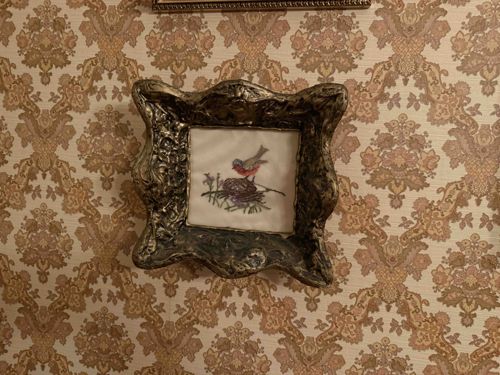
This item is a small-scale textile artwork, specifically a piece of embroidery or petit point, housed in a distinctive and heavy-set frame. The central textile portion features a bird, likely a robin, perched upon a nest with floral accents. It is rendered in a palette of muted greens, browns, and reds on an off-white silk or satin ground. The embroidery shows fine detail in the feathering and nest construction, indicative of skilled handwork, likely originating from the mid-20th century. The textile appears to be in fair condition, though there is visible puckering of the backing fabric suggesting a loss of tension over time. The frame is the most striking feature; it is a thick, ornate, and deeply textured molding with an 'organic' or grotto-style aesthetic. The finish is a dark, antiqued gold or bronze patina over what appears to be a composite or plaster-on-wood material. The frame’s exaggerated, undulated edges and rough-hewn texture provide a sharp contrast to the delicate needlework. There are no immediately visible maker's marks or signatures, but the overall style suggests a piece of decorative folk art or a custom-framed craft project from the 1960s-1970s. The backing and mounting seem intact, although the frame shows some dust accumulation in its crevices and minor wear consistent with domestic aging.
AI Appraisal Report

·AI can make mistakes·Verify before acting
I have examined the digital representations of this framed textile work, which features a bird and nest motif executed in traditional silk embroidery on a satin weave ground. My assessment places this piece as a mid-20th-century decorative craft item, likely produced between 1950 and 1970. The embroidery displays competent handwork, though it lacks the complexity of earlier 19th-century needlepoint or high-end bespoke works. The 'grotto' style composite frame, while visually striking and heavier than standard moldings, is characteristic of mass-produced decorative frames from the 1960s intended to add a sense of perceived value to hobbyist projects. Condition-wise, the textile shows signs of structural fatigue, specifically the puckering on the backing silk which suggests moisture fluctuations or failure of the mounting adhesive. The frame shows surface-level dust and minor patina wear, though it appears structurally sound. Market demand for such pieces is currently modest. They are primarily valued by collectors of folk art or retro interior designers for their 'kitsch' appeal rather than as fine art textiles. Comparables in antique malls and online vintage marketplaces generally realize between $40 and $100 depending on the size and frame integrity. Critically, a digital examination limits my ability to verify the material composition of the fibers or the substrate behind the textile. A physical inspection would be required to determine if the backing is acid-free or if the piece is protected by UV-filtering glass, which affects long-term preservation value. I would also need to remove the backing to check for a manufacturer's label or a private artist’s signature to confirm if this was a commercial kit or a unique commissioned work.

Get your items appraised

Instant estimates of your treasures with AI-powered appraisals

Browse More Appraisals