AI estimate as of July 18, 2025 · verify with a professional before acting
AI-Generated · Verify before acting
Everything on this page is generated by AI for informational purposes only. AI can make mistakes — the AI may misidentify items or misattribute them (artist, maker, brand, designer, origin, era). This is not an official valuation and should not be used for insurance, sale, tax, estate, legal, or lending purposes — or any decision requiring a certified appraisal. It is not an authoritative claim about any person, brand, or rights holder — do not share or rely on it as a factual statement about a third party. Always consult qualified professionals before making financial decisions.
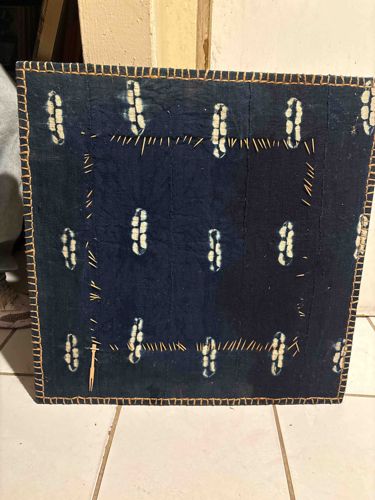
This item is a flat, square-shaped textile piece, possibly a wall hanging or cushion cover, featuring a deep indigo blue background with resist-dyed patterns. The principal pattern consists of eleven cream-colored, elongated oval or 'pod-like' shapes arranged in three columns. Each shape appears to be formed by multiple smaller, segmented resist areas, giving them a textured, almost speckled appearance. The dark blue field shows variations in color saturation, typical of natural indigo dyeing processes, with some areas appearing slightly lighter or mottled. The entire perimeter of the textile is finished with a rustic whip stitch or blanket stitch in a contrasting light-colored thread, likely a natural fiber such as raffia or undyed cotton string. This stitching is clearly hand-done, contributing to the artisanal quality of the piece. Additionally, there are sections of visible hand-stitching within the main field, particularly forming thin, linear, rectangular frames around the patterned areas. These stitches are also in a light-colored thread, some appearing as small, individual dashes and others forming longer, more continuous lines. The visible stitching suggests a patched or quilted construction, or perhaps decorative repair (sashiko-style mending). The textile exhibits a soft, somewhat wrinkled texture, indicating its age and usage. There are no obvious signs of major damage like tears or holes, but the overall patina suggests a vintage or antique origin. The craftsmanship, particularly the hand-dyeing and stitching, points to a traditional, possibly folk art, approach to textile creation. The geometric arrangement of the resist-dyed motifs combined with the visible hand-stitching suggests a piece from a culture with a rich history of textile production and repair, likely from Asia or Africa.
AI Appraisal Report
Based on my visual examination of the provided image, this Indigo Resist-Dyed and Hand-Stitched Textile presents as a charming example of traditional textile art. Its overall condition appears good, consistent with an item of vintage or antique origin that has been cared for; I observe a soft, somewhat wrinkled texture and variations in indigo saturation characteristic of natural dye processes. The visible hand-stitching, including the whip-stitched perimeter and linear rectangular frames, strongly suggests authenticity in its artisanal creation. The 'pod-like' resist-dyed motifs are distinctive and artistically arranged.
However, it's crucial to note the limitations of image-based appraisal. Without a physical examination, I cannot definitively assess the fiber content, precise age, the true tactile quality, or the presence of any minor flaws like subtle fading, small repairs not immediately obvious, or structural integrity of the stitching. Authenticity, particularly regarding the cultural origin (likely Asian or African as suggested by the style) and specific period, would greatly benefit from in-person inspection to evaluate weave structure, dye migration patterns, and microscopic examination of fibers. Provenance documentation, if available, would significantly enhance authentication and value.
Market conditions for global textile arts are generally stable, with growing interest in authentic, handmade, and ethically sourced vintage pieces. Comparables would include other antique or vintage indigo textiles, such as Japanese boro textiles, African indigo cloth, or Indian resist-dyed pieces, which range widely in value depending on age, intricacy, condition, and provenance. Demand for unique, hand-crafted folk art textiles remains consistent among collectors and interior designers. The visible hand-stitching, suggesting a potential sashiko or mending tradition, adds a layer of desirability and craftsmanship.
Factors significantly impacting value include its age (if genuinely antique, value increases), rarity of the specific resist pattern, country of origin, and confirmation of its handmade nature. Without definitive provenance or in-person inspection, the 'unknown origin' factor moderates the top-tier valuation. Should in-person examination confirm its antiquity and high-quality traditional craftsmanship from a known significant textile region, its value could lean towards the higher end of the range. For full authentication, I would recommend a physical inspection by a textile conservator or specialist, and if possible, archival research into similar traditional textile patterns.