AI estimate as of November 23, 2025 · verify with a professional before acting
AI-Generated · Verify before acting
Everything on this page is generated by AI for informational purposes only. AI can make mistakes — the AI may misidentify items or misattribute them (artist, maker, brand, designer, origin, era). This is not an official valuation and should not be used for insurance, sale, tax, estate, legal, or lending purposes — or any decision requiring a certified appraisal. It is not an authoritative claim about any person, brand, or rights holder — do not share or rely on it as a factual statement about a third party. Always consult qualified professionals before making financial decisions.
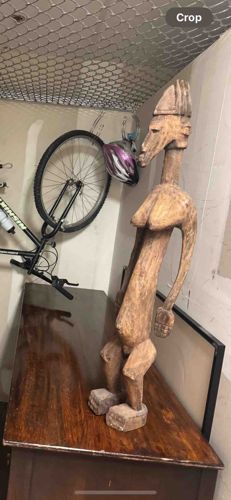
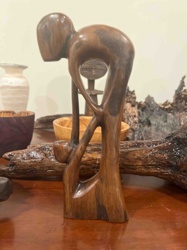
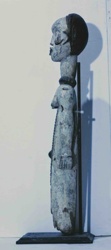
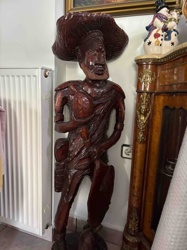
This item is a tall, slender carved wooden figure, likely representing a human or ancestral spirit from an African tribal tradition. The wood appears to be a medium-brown, natural tone, possibly hardwood, which has developed a rich patina over time, indicating age. The carving exhibits a somewhat rough, hand-hewn quality, with visible tool marks suggesting traditional craftsmanship rather than mass production. The figure stands on two block-like feet, with distinct, albeit abstract, anatomical features including pronounced breasts and a clearly defined head. The head is elongated with stylized facial features, and a distinctive headdress or hairstyle with carved lines is present. The arms are long and thin, bent at the elbows, with hands depicted in a somewhat simplified, blocky form. The overall proportions are elongated and stylized, characteristic of many African art forms. There are no obvious visible signs of significant damage like breaks or large chips, but surface wear, minor nicks, and the natural cracking and checking typical of aged wood are likely present upon closer inspection. No specific maker's marks or signatures are discernible from the image. The figure's aesthetic suggests it could be from West or Central Africa, possibly a ceremonial or decorative piece, and its style points to an earlier to mid-20th-century or potentially older origin, though further expert analysis would be needed to confirm. The craftsmanship is robust and intentional, demonstrating cultural significance and artistic skill.
AI Appraisal Report
Based on my visual examination of the African Tribal Carved Wood Figure, the overall condition appears to be good for its age. The rich patina, visible tool marks, and natural wood checking and minor surface wear are consistent with an authentically aged, hand-hewn piece. There are no obvious signs of significant repairs or major damage, which is a positive factor. The stylistic characteristics – elongated proportions, stylized facial features, and distinct headdress – strongly suggest authenticity within traditional African tribal art.
The market for tribal art remains robust, particularly for pieces exhibiting traditional craftsmanship and cultural significance. Comparables, especially from West or Central African regions, indicate that authentic, well-preserved figures of this size and stylistic quality typically fetch prices within the stated range. Demand is stable among collectors and enthusiasts seeking genuine ethnographic pieces. The carving's intentional robust craftsmanship and aesthetic appeal contribute to its desirability.
However, it is crucial to state the limitations of an image-based appraisal. While the visual indicators are positive, definitive authenticity cannot be fully established without physical inspection. I would need an in-person examination to assess the wood type, verify the age of the patina, scrutinize tool marks more closely for consistency, and check for any subtle repairs or alterations. Provenance documentation, detailing the item's history of ownership and origin, would significantly enhance authentication and value. Scientific testing, such as carbon dating, could provide definitive age confirmation but is often reserved for high-value pieces.