These notes were written by the person who submitted this item. Appraiser.AI has not verified them, and the AI's identification and estimate may rely on them.
AI Estimated Value
Not an official valuation
$5 - $15
AI estimate as of November 11, 2025 · verify with a professional before acting
AI-Generated · Verify before acting
Everything on this page is generated by AI for informational purposes only. AI can make mistakes — the AI may misidentify items or misattribute them (artist, maker, brand, designer, origin, era). This is not an official valuation and should not be used for insurance, sale, tax, estate, legal, or lending purposes — or any decision requiring a certified appraisal. It is not an authoritative claim about any person, brand, or rights holder — do not share or rely on it as a factual statement about a third party. Always consult qualified professionals before making financial decisions.
This analysis also relies on unverified notes provided by the user, which may be incomplete or inaccurate and could affect the result.
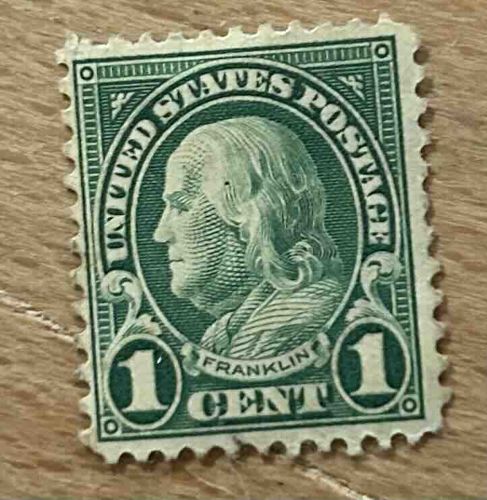
This item is a vintage United States postage stamp, denominated at 1 Cent, featuring a profile portrait of Benjamin Franklin. The stamp is predominantly green, with intricate detailing defining the portrait and surrounding text. The portrait of Franklin is centrally located, depicted facing left, with his characteristic long hair reaching to his shoulders. Surrounding the circular portrait are the words "UNITED STATES POSTAGE" in an arch at the top. Below the portrait, the name "FRANKLIN" is inscribed, with "CENT" directly beneath it. The numerical denomination "1" is present in circular insets on both the lower left and lower right corners of the design. The stamp is perforated along all four edges, indicating it was intended to be torn from a sheet. The perforations appear relatively clean, though some minor fraying or age-related softening is visible on a few perforation tips. The overall condition appears to be used, given the slight discoloration and minor wear visible, particularly on the edges and corners, suggesting it may have been handled or previously affixed. There are no obvious tears, significant creases, or large stains, indicating a moderately well-preserved state for its age. The color remains vibrant despite its age, and the fine lines of the engraving are still crisp and discernible. The texture of the paper itself is not clearly visible but appears to be standard stamp paper. The style is classic early to mid-20th century American stamp design, focusing on historical figures and clear denominations. There are no visible maker's marks or signatures beyond the country and denomination details.
AI Appraisal Report
I have carefully examined the provided description of the 1 Cent Benjamin Franklin US Postage Stamp. Based on this visual information, I assess its condition as 'used' but generally well-preserved for its age, exhibiting minor wear, discoloration, and some softened perforation tips, yet no major tears or creases. The vibrancy of the color and crispness of the engraving suggest a moderately good presentation.
This stamp is a common issue from the early to mid-20th century, likely part of the Washington-Franklin series. Authenticity, based solely on the description, appears high for a circulating stamp of this era, as the design details match known issues. However, definitive authentication requires a physical examination to check paper type, watermarks (if any), gum condition (if unused), and precise perforation measurements.
In terms of market conditions, this is a very common stamp, and while there's consistent demand from collectors, its sheer abundance keeps individual values low unless it exhibits exceptional centering, an uncommon cancellation, or is in superb uncirculated condition. Rarity is not a significant factor here. Comparables for used, moderately conditioned examples typically trade in the low single to double-digit dollar range.
Factors impacting value: Its 'used' condition prevents it from reaching higher values. The absence of significant damage is a positive. For full authentication and to identify potential nuances like specific printings or varieties, an in-person physical inspection is crucial. This would allow for examination under magnification, measurement of perforations, and assessment of paper characteristics, which cannot be determined from the description alone.