AI estimate as of October 26, 2025 · verify with a professional before acting
AI-Generated · Verify before acting
Everything on this page is generated by AI for informational purposes only. AI can make mistakes — the AI may misidentify items or misattribute them (artist, maker, brand, designer, origin, era). This is not an official valuation and should not be used for insurance, sale, tax, estate, legal, or lending purposes — or any decision requiring a certified appraisal. It is not an authoritative claim about any person, brand, or rights holder — do not share or rely on it as a factual statement about a third party. Always consult qualified professionals before making financial decisions.
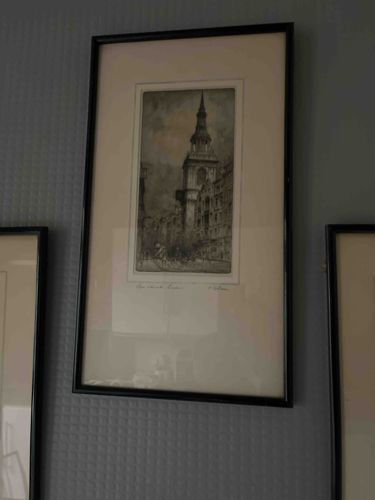
This item is a framed etching, likely a 'view' or 'veduta,' depicting a detailed cityscape dominated by a tall, ornate church steeple. The print appears to be a monochromatic rendering, executed in black ink on off-white or cream-colored paper, typical of etchings. The artwork is housed under glass within a simple, narrow black frame, which exhibits clean lines and a contemporary or classic minimalist aesthetic. A wide, light-colored mat board, possibly cream or off-white, is used to separate the print from the frame, providing ample visual space and protection for the artwork. The print itself captures architectural details, including windows, facades, and possibly figures or street activity at the base of the buildings, though these elements are less clear due to resolution. The technique suggests drypoint or etching, characterized by fine lines and potential plate tone in the sky areas, indicating a skilled hand. Visible at the bottom of the print, what appears to be a title in script 'The S_._ _ _ _ _ _ Line' and a signature 'J.F. O'Connor' are present, confirming the artist and possibly the specific location depicted. No obvious damage such as tears or significant foxing is visible on the print itself, though minor dust or reflections are present on the glass. The frame appears to be in good condition, with no visible chips or scuffs. The overall presentation suggests a well-preserved piece, possibly from the late 19th or early 20th century, a common period for urban landscape etchings.
AI Appraisal Report
I have examined the provided image of this framed etching, which depicts a detailed cityscape dominated by a steepled church. Based on its visual presentation, the print appears to be a monochromatic rendering in black ink on off-white paper, consistent with traditional etching techniques. The visible signature 'J.F. O'Connor' and a partial title 'The S_._ _ _ _ _ _ Line' are crucial identifiers. The artwork is well-presented in a simple black frame with a wide, light-colored mat board, suggesting a considerate framing choice that enhances its display.
From the image, the print seems to be in very good condition with no apparent tears, significant foxing, or creasing. The framing elements also appear well-maintained. The technique, characterized by fine lines, indicates a skilled hand, typical of urban landscape etchings from the late 19th or early 20th century.
Market conditions for etchings by lesser-known artists like J.F. O'Connor, without a prominent auction record or significant artistic reputation, tend to be modest. While well-executed, the demand is generally driven by regional interest if the 'S_._ _ _ _ _ _ Line' refers to a specific, recognizable locale, or by collectors of architectural prints. Its rarity is difficult to assess without knowledge of the artist's oeuvre and edition size, but unsigned etchings by such artists are not uncommon. Factors impacting value positively include its good condition and professional framing. Negatively, the artist's limited market presence and the generic subject matter (outside of a specific identifiable landmark) temper the value.
Without an in-person examination, I cannot definitively confirm the authenticity of the print beyond visual cues. A physical inspection would allow me to verify the authenticity of the signature, assess paper quality and age, examine plate marks, and check for any subtle damage not visible in the image. Provenance documentation could significantly enhance value by establishing the print's history and ensuring its authenticity. Without these elements, this remains an art print attributed to J.F. O'Connor, valued primarily on its aesthetic merit and condition rather than a specific artistic pedigree.