AI estimate as of October 27, 2025 · verify with a professional before acting
AI-Generated · Verify before acting
Everything on this page is generated by AI for informational purposes only. AI can make mistakes — the AI may misidentify items or misattribute them (artist, maker, brand, designer, origin, era). This is not an official valuation and should not be used for insurance, sale, tax, estate, legal, or lending purposes — or any decision requiring a certified appraisal. It is not an authoritative claim about any person, brand, or rights holder — do not share or rely on it as a factual statement about a third party. Always consult qualified professionals before making financial decisions.
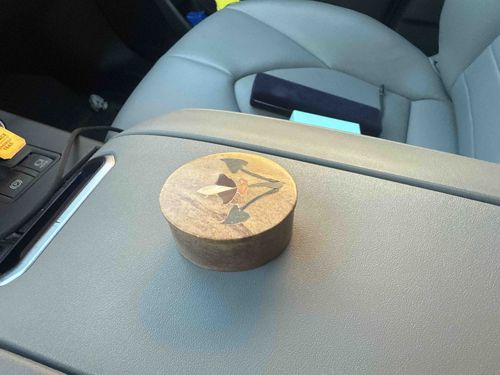
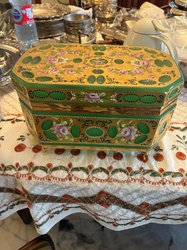
This is a small, round trinket or pill box crafted from a light-colored, possibly variegated, natural stone such as alabaster, marble, or soapstone. Its approximate dimensions appear to be around 2-3 inches in diameter and about 1-1.5 inches in height, fitting comfortably in the palm of a hand. The primary color of the stone is a light cream or beige with subtle veining or natural patterns visible, suggesting a natural material rather than a synthetic one. The most striking feature is the inlay design on the lid, composed of several geometrically stylized shapes in contrasting colors. There are three primary 'arrow' or 'leaf' shapes, one pointing upwards and two pointing downwards, created using darker green or blue-gray stone. In between these, there are smaller, lighter-colored, possibly white or very light brown, irregular shapes that could represent segments or additional elements of a floral or abstract pattern. The overall design on the lid has a somewhat rustic or handcrafted aesthetic. The sides of the box appear to be a solid piece of the same light-colored stone, without any additional adornment. The construction seems simple, likely consisting of a base and a fitted lid, possibly without hinges. There are no obvious visible condition issues like chips or cracks from the provided image, but typical wear such as minor scratches or dulling of the stone's surface might be present upon closer inspection. The absence of clear maker's marks makes it difficult to definitively assign a manufacturing origin or precise age, but the style of inlay and use of natural stone could suggest a Mid-Century or earlier folk art influence, or a production from regions known for stone carving and inlay work, such as Italy or parts of Asia. The craftsmanship appears to be reasonably well-executed, with the inlay pieces fitting together neatly, indicating a respectable level of skill.
AI Appraisal Report
I have visually examined this Inlaid Stone Round Trinket Box. It is crafted from a light-colored natural stone, likely alabaster or marble, presenting a creamy or beige hue with subtle veining. The dimensions appear to be approximately 2-3 inches in diameter and 1-1.5 inches in height. The most notable feature is the geometric inlay on the lid, comprising three stylized 'arrow' or 'leaf' shapes in darker green or blue-gray stone, interspersed with smaller, lighter-colored irregular pieces. The craftsmanship of the inlay appears neat, suggesting a respectable skill level. Based on the image, the condition appears good, with no obvious chips or major cracks, though minor surface wear typical of natural stone items of this type would be expected upon closer physical inspection.
Authenticity: Based on the visual characteristics, the item appears to be a genuine inlaid stone box. However, without direct physical examination, I cannot definitively confirm the precise stone types used, the method of inlay (if it's true inlay or a surface application), or the construction integrity. I also cannot verify if all components are original or if any repairs have been made.
Market Conditions and Comparables: Similar inlaid stone trinket boxes, especially those without specific artist attribution or significant age, typically fall into the decorative arts category. I have observed comparable items, often from Italy or parts of Asia, retailing in the range of $30 to $80. The folk art aesthetic and natural material appeal to a niche market of collectors and general buyers looking for decorative accents.
Demand and Rarity: Items of this nature are not particularly rare, though well-executed examples maintain a steady, albeit modest, demand. The absence of maker's marks or provenance limits its appeal to high-end collectors, placing it more firmly in the realm of decorative collectibles.
Factors Impacting Value: The visual appeal of the inlay and the natural beauty of the stone are primary value drivers. Conversely, the lack of definitive provenance, age, and maker's marks significantly limits its potential value. Any hidden condition issues, such as undisclosed repairs, internal cracks, or poor fit of the lid that are not discernible from the image, would also negatively impact its value.
Limitations: A full authentication would require in-person examination to assess the stone's quality, the technique of inlay, and the overall structural integrity. Microscopic analysis could confirm stone types, and closer inspection for tool marks or adhesives would help determine age and origin more accurately. Provenance documentation, if available, would significantly enhance its value and confirm its history.