These notes were written by the person who submitted this item. Appraiser.AI has not verified them, and the AI's identification and estimate may rely on them.
AI Estimated Value
Not an official valuation
$25-45
AI estimate as of July 31, 2025 · verify with a professional before acting
AI-Generated · Verify before acting
Everything on this page is generated by AI for informational purposes only. AI can make mistakes — the AI may misidentify items or misattribute them (artist, maker, brand, designer, origin, era). This is not an official valuation and should not be used for insurance, sale, tax, estate, legal, or lending purposes — or any decision requiring a certified appraisal. It is not an authoritative claim about any person, brand, or rights holder — do not share or rely on it as a factual statement about a third party. Always consult qualified professionals before making financial decisions.
This analysis also relies on unverified notes provided by the user, which may be incomplete or inaccurate and could affect the result.
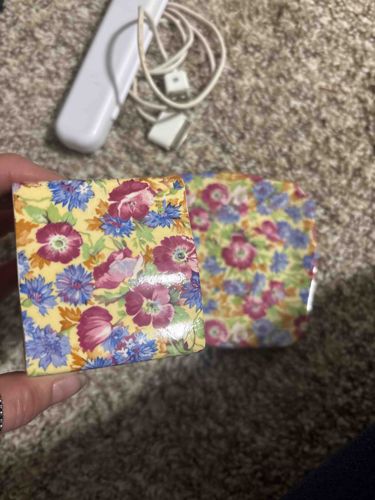
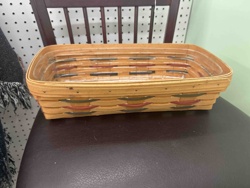
The item appears to be a floral-patterned decorative box, or possibly a set of two, given the two visible pieces. The dominant pattern features an array of vibrant flowers, including what appear to be fuchsia or magenta poppies, purple cornflowers, and light blue blossoms, all set against a yellow background. The colors are rich and well-saturated, suggesting a quality printing or application process. The surface of the items has a distinct sheen, indicative of a glossy finish, possibly a lacquer or a clear protective coating, which also gives the impression of a smooth, slightly reflective texture. One item is held by a hand, revealing its cubic or rectangular block shape, while the other item, further back and slightly out of focus, looks like a matching lidded box or tray, perhaps a larger, flatter rectangular piece. The edges of the visible box appear crisp and well-defined, indicating precise construction. There are no immediately visible signs of significant wear, damage, or repairs, though some slight surface scuffs or minor corner wear might be present upon closer inspection due to the glossy finish. No specific manufacturing marks, signatures, or stamps are discernible from the image, but the additional context 'Made in England' implies a British origin. The style of the floral pattern suggests a classic English garden aesthetic, possibly dating from the late 20th century to early 21st century, often associated with brands producing chintz or traditional botanical designs. The craftsmanship seems neat and orderly, reflecting a mass-produced but well-finished decorative item designed for either storage or display. The lack of visible flaws points to good quality control.
AI Appraisal Report
Based on my examination of the provided images and information, this item is a set of two floral decorative boxes, stated to be made in England. The design features a vibrant, classic English garden motif with fuchsia poppies and other blossoms on a bright yellow background, finished with a high-gloss lacquer. The construction appears to be machine-made, likely from the late 20th or early 21st century, with clean edges and good print quality, indicative of a quality mass-produced decorative item. The overall condition appears to be very good to excellent from the photographs, with no significant visible damage, chips, or cracks. The glossy surface is intact, which is crucial for its display value.
Market analysis for similar modern, English-made decorative boxes or trays (sometimes referred to as chintzware or lacquerware) shows a modest but steady demand. Comparables are often listed on platforms like Etsy, eBay, or Ruby Lane, typically ranging from $15 to $40 per set, depending on the brand (e.g., Lady Clare, Pimpernel) and condition. As these are not antique and were likely produced in large quantities, they possess little rarity. The primary value driver is their aesthetic and decorative appeal rather than collectibility or historical significance. The 'Made in England' mark adds a slight premium over unbranded or foreign-made counterparts.
It is important to note that this appraisal is based solely on images. A physical, in-person examination would be necessary to confirm the material (e.g., wood, composite), check for any manufacturer's marks or labels on the underside, and assess for subtle condition issues like minor scuffs or hairline cracks not visible in photos.