AI estimate as of September 23, 2025 · verify with a professional before acting
AI-Generated · Verify before acting
Everything on this page is generated by AI for informational purposes only. AI can make mistakes — the AI may misidentify items or misattribute them (artist, maker, brand, designer, origin, era). This is not an official valuation and should not be used for insurance, sale, tax, estate, legal, or lending purposes — or any decision requiring a certified appraisal. It is not an authoritative claim about any person, brand, or rights holder — do not share or rely on it as a factual statement about a third party. Always consult qualified professionals before making financial decisions.
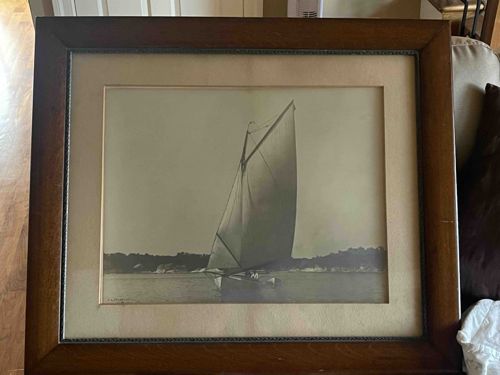
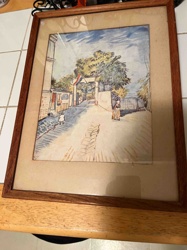
This item is a framed photographic print depicting a sailing vessel on a body of water, likely a lake or bay, with a shoreline dotted with trees in the background. The print is monochrome, presenting in shades of gray and subtle sepia tones, suggesting an older photographic process or an intentional artistic choice to evoke a vintage aesthetic. The sailboat features a prominent triangular main sail and possibly a jib, characteristic of a gaff-rigged or catboat design, although precise rigging details are hard to discern. There appear to be one or more figures in the boat, adding a sense of scale and activity. The print is housed under glass within a substantial wooden frame, which exhibits a warm, medium-to-dark brown finish with visible wood grain, suggesting a hardwood like oak or mahogany. The frame has a classic, slightly molded profile. Inside the frame, a light-colored mat board, likely a creamy off-white or light beige, surrounds the print, providing a visual border and separation from the frame. There's also a narrow, possibly decorative, inner lining or fillet between the mat and the print itself, which appears to have a subtle beaded or roped pattern in a darker tone. The overall condition of the frame shows some minor surface wear, including a few small scuffs or scratches visible on the right side, consistent with age and handling. The print itself appears to be in good condition, with no obvious signs of significant discoloration, foxing, or damage, though a slight yellowing of the mat suggests some age. The style suggests it could be from the early to mid-20th century. The craftsmanship of the frame appears solid, indicating a commercial framing job rather than a custom one. This piece offers a serene nautical scene, indicative of a classic maritime art preference.
AI Appraisal Report
I have examined the provided image of this framed nautical seascape photographic print. The print itself appears to be a monochrome image, likely an older photograph or one intentionally processed for a vintage look, depicting a serene sailing scene. The condition of the print seems good, with no obvious signs of significant damage or foxing. However, the slightly yellowed mat suggests age. The frame is a substantial wooden piece with a classic profile and some visible wear, including scuffs on the right side, typical for an item of its age. The framing appears commercial rather than custom.
From a market perspective, framed vintage photographic prints of generic nautical scenes generally have a moderate demand. This piece lacks a discernible artist's signature, edition number, or specific historical significance, which limits its value as fine art. Comparable items, often found in antique shops or online marketplaces, typically fetch prices based more on their decorative appeal and framing quality than artistic merit or rarity.
Factors impacting its value include its decorative appeal, good overall condition despite minor frame wear, and the perceived age. Without knowing the photographer, the print's specific process (e.g., silver halide, albumen), or its exact age, it remains in the category of decorative art. The craftsmanship of the frame is solid, adding to its presentation.
Limitations: Authenticity verification is severely limited by visual examination alone. A physical inspection would be crucial to determine the photographic process, assess the paper quality, and check for any hidden damage or artists' marks that might be obscured by the mat or frame. Provenance documentation would be essential to establish its history, origin, and potential artist. Scientific testing, if warranted, could confirm the print's age and materials precisely. Without these, it's impossible to confirm specific authenticity beyond what is visible.