AI Appraisal Estimate

AI-generated estimates · not official valuations

From the user

What was submitted

Photo and notes provided by the user — not generated by AI

Submitted item photo
Submitted photo · June 30, 2026

User's notes

No additional notes provided.

AI analysis below

AI appraisal

AI analysis & estimate

AI-Generated · Verify before acting

Everything below is generated by AI for informational purposes only. AI can make mistakes — the AI may misidentify items or misattribute them (artist, maker, brand, designer, origin, era). This is not an official valuation and should not be used for insurance, sale, tax, estate, legal, or lending purposes — or any decision requiring a certified appraisal. It is not an authoritative claim about any person, brand, or rights holder — do not share or rely on it as a factual statement about a third party. Always consult qualified professionals before making financial decisions.

Read the full disclaimer

AI Identification

·Not independently authenticated·Verify before acting

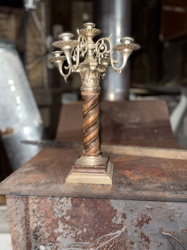
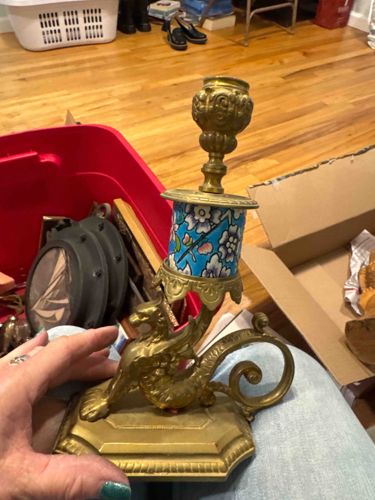
French Gilt Bronze and Champlevé Enamel Candlestick with Chimera Base

Antique Decorative Arts / Lighting

AI Estimated Value

·Not an official valuation·Verify before acting

$450 – $650

As of June 30, 2026

AI Item Analysis

·AI can make mistakes·Verify before acting
This is a decorative nineteenth-century style or late-Victorian era candlestick featuring a sophisticated combination of gilt bronze (ormolu) and champlevé enamel work. The piece stands on a stepped, rectangular cast bronze base with a beading-style textured border. The most prominent structural feature is a highly stylized mythological sea-beast or chimera, which acts as the riser for the candle holder. This creature is cast with intricate details showing scales and a curved tail that forms a handle-like scroll. Above the chimera sits a cylindrical central column decorated with vibrant champlevé enameling, featuring white and blue floral motifs against a brilliant turquoise-blue background. The top candle cup exhibits an urn-like shape with embossed scrollwork and gadrooned edges. The overall construction suggests an eclecticism typical of the Second Empire or Napoleon III style, likely originating from France or a high-quality Continental workshop during the mid-to-late 1800s. The metal shows a soft, aged patina with some darkening in the recessed areas, which is consistent with its age and helps highlight the depth of the casting. There are no immediate signs of significant repair or enamel loss visible, though there is a light dulling to the gilt finish which indicates historical use and natural oxidation. The craftsmanship is refined, particularly in the balance between the heavy neoclassical bronze elements and the delicate, colorful enamel work.
AI Appraisal Report

·AI can make mistakes·Verify before acting
Based on my visual examination of the provided images, this piece appears to be a genuine late 19th-century French candlestick in the Napoleon III taste, exhibiting the characteristic eclecticism of the Second Empire period. The combination of the heavy, cast chimera base with the delicate champlevé enamel column is a hallmark of high-quality Continental workshops of this era, likely French, possibly imitating the earlier Renaissance Revival styles. The condition appears generally good for its age. The gilt bronze retains a pleasing, soft patina, though the 'dulling' noted suggests the original mercury gilding has worn or oxidized over time, a natural sign of authenticity. The enamel work is the critical value driver here; based on the images, the vibrant turquoise ground and floral motifs seem intact, without the spider-web cracking or significant chip losses often seen in lower-quality examples. The casting of the chimera is competent, though perhaps lacking the supreme sharpness found in works by top-tier makers like Barbedienne. The market for 19th-century decorative singular candlesticks is currently softer than for pairs. A single stick is primarily valued as a cabinet piece rather than functional lighting. Comparables for single candlesticks of this quality generally hammer between $300 and $600 at auction, though retail prices can be higher. Limitations: My appraisal assumes the enamel is free of professional restoration, which is indistinguishable in photos. To fully authenticate the piece as 19th-century rather than a high-quality 20th-century reproduction, I would need to physically inspect the threading on the underside and the weight of the bronze. Furthermore, checking for a tiny maker's foundry mark (often hidden under the base rim) would be essential for a higher valuation.

Get your items appraised

Instant estimates of your treasures with AI-powered appraisals

Browse More Appraisals