These notes were written by the person who submitted this item. Appraiser.AI has not verified them, and the AI's identification and estimate may rely on them.
AI Estimated Value
Not an official valuation
$100 - $180
AI estimate as of November 29, 2025 · verify with a professional before acting
AI-Generated · Verify before acting
Everything on this page is generated by AI for informational purposes only. AI can make mistakes — the AI may misidentify items or misattribute them (artist, maker, brand, designer, origin, era). This is not an official valuation and should not be used for insurance, sale, tax, estate, legal, or lending purposes — or any decision requiring a certified appraisal. It is not an authoritative claim about any person, brand, or rights holder — do not share or rely on it as a factual statement about a third party. Always consult qualified professionals before making financial decisions.
This analysis also relies on unverified notes provided by the user, which may be incomplete or inaccurate and could affect the result.
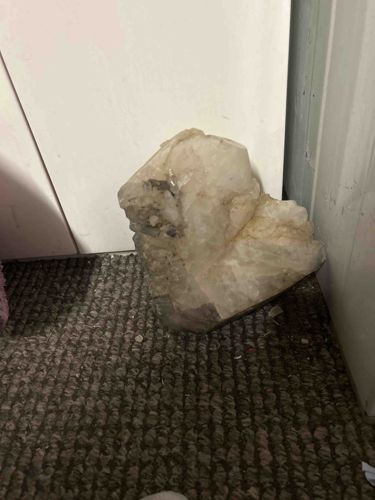
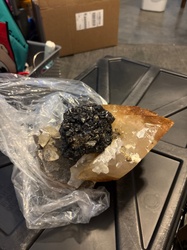
This item is a substantial natural quartz crystal cluster specimen, likely a variety of clear or milky quartz, given its translucent to opaque appearance. The overall shape is irregular and organic, characteristic of natural mineral formations, with multiple crystal terminations and growth patterns visible. Its color ranges from a milky white to a light yellowish-brown, suggesting the presence of mineral inclusions or iron staining, particularly in the more opaque areas and crevices. Some darker, greyish-brown patches, possibly dirt or other mineral adhesion, are noticeable on several surfaces, indicating that the specimen has not been fully cleaned or polished. The surface texture appears somewhat rough and unrefined, typical of a raw, unworked mineral. The size is considerable, as it occupies a significant portion of the image frame when placed on the carpet next to a wall, suggesting it could be a large display piece. No specific manufacturing marks or signatures are discernible as it is a natural formation. The visible condition includes natural wear, some dirt accumulation in the fissures, and staining, all of which are common for excavated or uncleaned mineral specimens. The craftsmanship is entirely natural, showcasing geological processes rather than human intervention. Its estimated age would be geological, formed over millions of years. This specimen possesses unique aesthetic qualities due to its natural crystallography and color variations.
AI Appraisal Report
Upon visual examination of the provided images, this item presents as a large, natural quartz cluster specimen. The piece exhibits an organic, irregular form with multiple crystal terminations characteristic of raw mineral formations. The color is predominantly milky to slightly translucent white with yellowish-brown to greyish staining, likely due to iron inclusions or external mineral deposits. Its substantial size makes it suitable as a decorative or collector's piece. Based on the images, the condition appears fair for a raw, uncleaned specimen, with dirt and accretions visible in the crevices. There are no signs of artificial manipulation, suggesting it is a natural geological formation.
The market for large, common variety quartz clusters is quite saturated. While the size is a positive value factor, the overall quality, including clarity, color, and perfection of crystal points, is moderate. Comparables of similar size and quality are readily available and typically sell in the $100 to $200 range. The lack of exceptional clarity, unique inclusions, or a specific desirable locality (like Arkansas or Brazil) prevents it from commanding a higher price. Demand is steady but is met by ample supply, which keeps values accessible.
It is important to note that this appraisal is based solely on images. An in-person examination is necessary for a definitive assessment. This would allow me to verify the mineral's authenticity, test its hardness, check for repairs or enhancements not visible in photos, and more accurately assess the clarity and luster of the crystal faces. Without provenance or geological testing, determining the specific origin, which can impact value, is impossible, and full authentication cannot be guaranteed.