AI estimate as of October 22, 2025 · verify with a professional before acting
AI-Generated · Verify before acting
Everything on this page is generated by AI for informational purposes only. AI can make mistakes — the AI may misidentify items or misattribute them (artist, maker, brand, designer, origin, era). This is not an official valuation and should not be used for insurance, sale, tax, estate, legal, or lending purposes — or any decision requiring a certified appraisal. It is not an authoritative claim about any person, brand, or rights holder — do not share or rely on it as a factual statement about a third party. Always consult qualified professionals before making financial decisions.
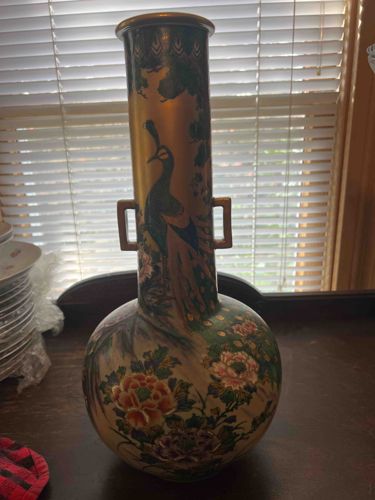
This appears to be a large Japanese satsuma-style floor vase, characterized by its distinctive form and decorated with vibrant enamel work. The vase features a tall, cylindrical neck that flares slightly at the rim, transitioning into a broad, globular body. The primary color palette is a rich golden-ochre base, complemented by intricate designs in varying shades of green, blue, pink, red, and purple, with black outlines and possibly gilded accents. The neck exhibits stylized patterns resembling a border or band, while the main body of the neck and the shoulder of the globe feature a majestic peacock with an elaborate tail, rendered in blues and greens. Below the peacock, and extending around the widest part of the globe, are large, lush peony blossoms in various stages of bloom, surrounded by foliage. There are two rectangular loop handles, one visible on each side of the neck, suggesting a symmetrical design. The craftsmanship appears to be of good quality, with detailed brushwork evident in the plumage of the peacock and the petals of the flowers. There are no visible chips, cracks, or significant repairs, though some slight surface wear or patina consistent with age might be present upon closer inspection. The overall style and decorative motifs suggest a production period likely from the late 19th to early 20th century, consistent with the popularity of Satsuma ware for export during that era. The large size implies it was intended as a decorative floor piece.
AI Appraisal Report
I have virtually examined this large Japanese Satsuma-style floor vase, noting its distinctive globular form with a tall neck and integrated loop handles. The rich golden-ochre base, detailed peacock, and lush peony motifs executed in vibrant enamels with black outlines and likely gilding are characteristic of late 19th to early 20th-century export Satsuma ware. The quality of brushwork, particularly in the peacock's plumage and the peony petals, appears quite fine, indicating a well-executed piece. A preliminary assessment suggests good overall condition, with no visible chips, cracks, or major repairs from the images provided. However, actual surface wear, patina, and potential minor restorations would require a direct, in-person examination.
Satsuma-style large floor vases with appealing decorative motifs like peacocks and peonies generally observe consistent demand in the decorative arts market. The scale of this piece enhances its collectible appeal as a significant decorative statement. Comparable sales for well-preserved, larger Satsuma-style vases of this era, particularly those with intricate figural or animal and floral designs, typically fall within the specified range. The presence of two loop handles further adds to its stylistic integrity and desirability.
Factors impacting value positively include the apparent good condition, attractive subject matter, and large size. The key limitation for full authentication and accurate valuation is the lack of physical inspection. Without examining the marks on the base, if any, and assessing the texture of the glaze, the quality of gilding (if present), and the weight and construction, a definitive attribution to a specific workshop or confirmation of true Satsuma ware (as opposed to Satsuma-style) remains challenging. Provenance documentation would also significantly aid in confirming its history and authenticity.