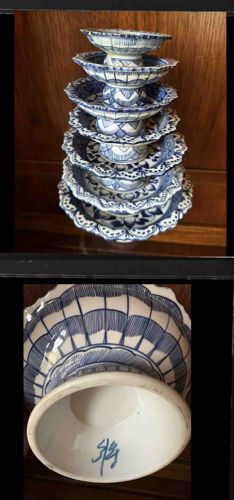
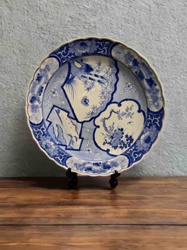
Vintage, blue and white porcelain pedestal dishes, of Asian origin.
These notes were written by the person who submitted this item. Appraiser.AI has not verified them, and the AI's identification and estimate may rely on them.
AI Estimated Value
Not an official valuation
$600-900
AI estimate as of September 7, 2025 · verify with a professional before acting
AI-Generated · Verify before acting
Everything on this page is generated by AI for informational purposes only. AI can make mistakes — the AI may misidentify items or misattribute them (artist, maker, brand, designer, origin, era). This is not an official valuation and should not be used for insurance, sale, tax, estate, legal, or lending purposes — or any decision requiring a certified appraisal. It is not an authoritative claim about any person, brand, or rights holder — do not share or rely on it as a factual statement about a third party. Always consult qualified professionals before making financial decisions.
This analysis also relies on unverified notes provided by the user, which may be incomplete or inaccurate and could affect the result.
This is a graduated set of seven vintage blue and white porcelain pedestal dishes, likely of Asian origin, possibly Japanese or Chinese. Each dish features a scalloped rim and sits atop a flared pedestal base. The decoration is applied in underglaze cobalt blue on a white porcelain body. The pattern on the upper surface of the dish appears to be a floral or geometric motif, while the exterior of the bowl and the pedestal are adorned with a repeating pattern, possibly stylized waves or scales, and lattice work. The varying sizes allow them to stack neatly, creating an attractive tiered display. The craftsmanship appears to be of good quality, with consistent patterns and a smooth glaze. The visible condition suggests some age, with a potential for minor wear consistent with vintage porcelain, though no prominent chips or cracks are immediately discernible from the image. The underside of the largest pedestal base reveals a blue painted mark, which appears to be a four-character reign mark or potter's mark, indicating manufacturing details and potentially helping to date the pieces more precisely. The style suggests a traditional East Asian aesthetic, common in porcelain produced from the late 19th to mid-20th century. The blue and white coloration is a classic and enduring decorative scheme for Asian ceramics.
AI Appraisal Report
I have carefully examined the provided image of this graduated set of seven vintage blue and white porcelain pedestal dishes. Based on the visual evidence, these items appear to be authentic examples of East Asian porcelain, likely originating from China or Japan, given the traditional blue and white underglaze decoration and forms. The craftsmanship, with consistent patterns, scalloped rims, and flared pedestal bases, suggests good quality manufacturing. The visible condition appears to be very good for vintage porcelain; I do not discern any obvious chips, cracks, or significant repair, only minor wear consistent with age, which is expected. The ability to stack neatly is a desirable feature.
In terms of market conditions, blue and white porcelain, especially graduated sets, continues to enjoy strong demand among collectors of Asian decorative arts. While not exceedingly rare, a complete set in good condition adds to its desirability. Comparables for similar vintage Chinese or Japanese blue and white pedestal dishes or tiered serving sets typically range from a few hundred to over a thousand dollars, depending on provenance, exact age, and artistic merit. The four-character mark visible on the largest base is a critical factor; if it is a genuine reign mark from a desirable period (e.g., Kangxi, Qianlong), or a recognized potter's mark, it would significantly enhance value. Conversely, a later apocryphal mark would not add significant value beyond the decorative appeal.
It is imperative to state the limitations of this appraisal based solely on an image. While the visual cues are positive, definitive authenticity requires in-person examination. A physical inspection would allow me to assess the exact weight, feel the glaze quality, examine firing imperfections, and identify any subtle repairs not visible in photographs. Comprehensive authentication would ideally involve a detailed examination of the mark by a specialist in Chinese or Japanese ceramics, and ideally, provenance documentation. Scientific testing, such as thermoluminescence, could definitively date the pieces, though this is usually reserved for higher-value, contentious items.