AI estimate as of December 12, 2025 · verify with a professional before acting
AI-Generated · Verify before acting
Everything on this page is generated by AI for informational purposes only. AI can make mistakes — the AI may misidentify items or misattribute them (artist, maker, brand, designer, origin, era). This is not an official valuation and should not be used for insurance, sale, tax, estate, legal, or lending purposes — or any decision requiring a certified appraisal. It is not an authoritative claim about any person, brand, or rights holder — do not share or rely on it as a factual statement about a third party. Always consult qualified professionals before making financial decisions.
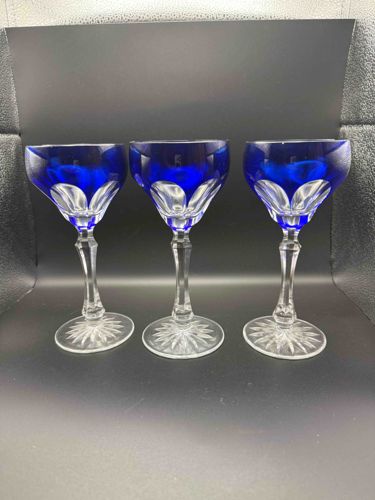
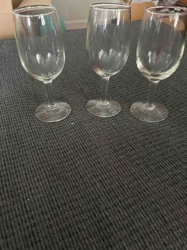
This set of three stemware glasses features a striking combination of deep cobalt blue and clear crystal. Each glass is composed of three main parts: a bowl, a stem, and a foot. The upper portion of the bowl is a rich, opaque cobalt blue, showing some translucency when light passes through the thinner areas, suggesting a cased or flashed glass technique. Below the blue, the bowl transitions into clear cut crystal, exhibiting distinct, petal-like or fluted cuts that form an elegant design, rising from the stem. The clear crystal stems are faceted or molded, showing a subtle tapering design, and connect seamlessly to the clear circular foot. The foot of each glass is adorned with a starburst pattern, comprising numerous radial cuts emanating from the center, adding to the decorative appeal and brilliance of the pieces. The overall construction appears to be machine-made or hand-finished crystal, indicative of quality glassware. There are no immediate visible signs of extensive wear, chips, cracks, or repairs from the provided image, suggesting they are in good to excellent condition. The uniformity in design and color across all three glasses indicates they were likely part of a larger set or manufactured as a matching trio. These glasses could be used for wine, champagne, or other beverages, or purely for decorative purposes. The style suggests an estimated age from the mid to late 20th century, a period often associated with vibrant colored and cut crystal production. The craftsmanship, particularly the detailed cutting on both the bowl and the foot, points to a moderate to high level of quality in their manufacture.
AI Appraisal Report
Based on my visual examination of the provided image, this set of three cobalt blue and clear cut crystal stemware glasses appears to be in very good to excellent condition. I observe no immediate chips, cracks, repairs, or significant wear, suggesting careful ownership. The uniformity in color and cutting across all three pieces supports their authenticity as a matching set. The deep cobalt blue, a popular color in mid-to-late 20th-century glass, combined with the detailed clear crystal cutting and starburst foot, indicates a decorative and functional item from that period, likely either machine-made with hand-finishing or semi-handcrafted. While the quality appears good, without a maker's mark or specific provenance, attributing them to a high-end manufacturer like Moser or Baccarat is impossible from an image alone.
Market conditions for colored and cut crystal stemware are stable, with a moderate demand for sets in good condition. Comparables for similar mid-century two-tone cut crystal glasses typically range from $20 to $40 per glass, depending on the intricacy of the cut and reputation of the maker. The aesthetic appeal of the cobalt blue and clear contrast is a strong selling point. However, being a set of three rather than a more standard set of four, six, or eight, slightly impacts its appeal to collectors looking for complete sets, thus moderately affecting value.
Factors impacting value positively include the excellent apparent condition and attractive design. The main limitation in this appraisal is the absence of a physical inspection. A hands-on examination would allow for tactile assessment of glass quality, identification of potential small flaws, and detection of manufacturer etching or marks. Full authentication and a more precise valuation would require in-person inspection and, ideally, provenance documentation to confirm the maker and exact age.