AI estimate as of November 27, 2025 · verify with a professional before acting
AI-Generated · Verify before acting
Everything on this page is generated by AI for informational purposes only. AI can make mistakes — the AI may misidentify items or misattribute them (artist, maker, brand, designer, origin, era). This is not an official valuation and should not be used for insurance, sale, tax, estate, legal, or lending purposes — or any decision requiring a certified appraisal. It is not an authoritative claim about any person, brand, or rights holder — do not share or rely on it as a factual statement about a third party. Always consult qualified professionals before making financial decisions.
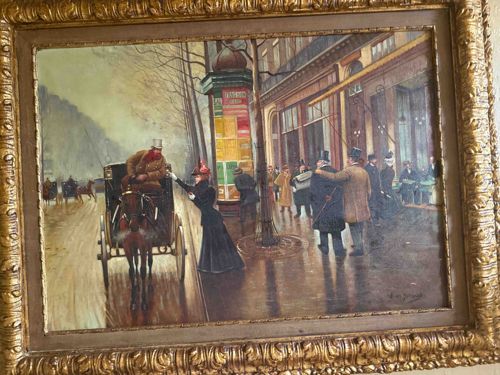
This is an oil painting depicting a bustling Parisian street scene, likely set during the late 19th or early 20th century. The artwork is framed in an ornate, gilded wooden frame with intricate scrollwork and floral motifs, showing some signs of wear and minor loss of gilding consistent with age. The painting itself features a subdued color palette, typical of urban scenes from that period, with grays, browns, and muted greens dominating, punctuated by brighter accents in clothing and storefronts. On the left side, a horse-drawn carriage is prominent, with a driver in a top hat and a woman in a long black dress and distinctive red hat interacting near the carriage. The street appears damp, suggesting rain or reflections, creating a soft, diffused light. On the right, a lively street-side cafe or shop is visible with several figures, including gentlemen in top hats and what appears to be a kiosk adorned with colorful posters or advertisements. The brushwork appears somewhat loose and impressionistic, capturing the atmosphere rather than precise detail. There's a visible signature in the lower right corner, though indecipherable from the image quality, which could be a key identifier. The overall condition of the painting seems good for its apparent age, with no obvious major tears or extensive paint loss, though some minor cracking or craquelure might be present upon closer inspection, which is common for older oil paintings. The varnish may have yellowed slightly over time, contributing to the overall warm tone.
AI Appraisal Report
Based on my visual examination of the provided image, this Parisian Street Scene Oil Painting appears to be in good overall condition for its age. The ornate gilded frame shows expected wear and minor gilding loss, consistent with an older piece. The painting itself exhibits a subdued yet atmospheric color palette, typical of late 19th or early 20th-century urban scenes. I observe loose, impressionistic brushwork, which effectively captures the dynamism of the street. There are no obvious major tears or extensive paint loss visible, though minor craquelure and slight yellowing of the varnish are likely, contributing to its warm tone, and are common for oil paintings of this period.
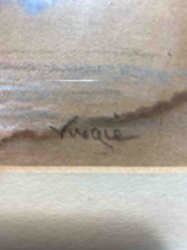
Market conditions for unsigned or unidentified Parisian street scenes with this level of quality are generally stable, driven by aesthetic appeal. Comparable works by lesser-known artists often fetch values in the low to mid-thousands. The presence of a horse-drawn carriage, diverse figures, and a detailed street-side cafe contribute to its narrative appeal, enhancing demand. The indecipherable signature in the lower right corner is a significant factor impacting value; a clear identification of the artist could dramatically increase its worth if it were a recognized name.
My primary limitation in this appraisal is the reliance on images alone. For full authentication and a more precise valuation, an in-person examination is crucial. This would allow me to definitively assess the condition, confirm the medium and age through a physical inspection of the canvas and paint layers (e.g., craquelure patterns, stretcher marks), and potentially decipher the signature under magnification. Scientific testing, such as pigment analysis or UV light examination for previous restorations, would also provide a more comprehensive assessment. Furthermore, any provenance documentation detailing the painting's ownership history would be invaluable for establishing authenticity and further impacts its market value. Without absolute certainty of the artist, I place the appraisal value between $3,000 and $5,000, reflecting its decorative quality, period aesthetic, and good condition.