AI Appraisal Estimate

AI-generated estimates · not official valuations

From the user

What was submitted

Photo and notes provided by the user — not generated by AI

Submitted item photo
Submitted photo · June 20, 2026

User's notes

No additional notes provided.

AI analysis below

AI appraisal

AI analysis & estimate

AI-Generated · Verify before acting

Everything below is generated by AI for informational purposes only. AI can make mistakes — the AI may misidentify items or misattribute them (artist, maker, brand, designer, origin, era). This is not an official valuation and should not be used for insurance, sale, tax, estate, legal, or lending purposes — or any decision requiring a certified appraisal. It is not an authoritative claim about any person, brand, or rights holder — do not share or rely on it as a factual statement about a third party. Always consult qualified professionals before making financial decisions.

Read the full disclaimer

AI Identification

·Not independently authenticated·Verify before acting

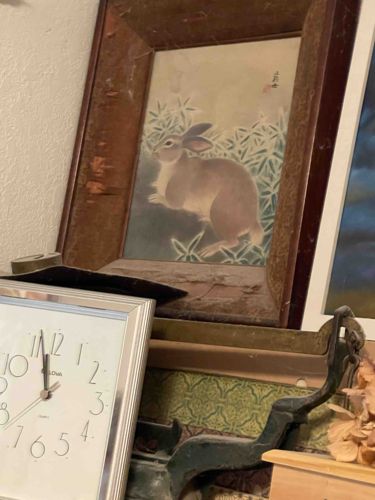
Japanese Nihonga Painting of a Rabbit in Bamboo

Fine Art - East Asian Painting

AI Estimated Value

·Not an official valuation·Verify before acting

$400 - $700

As of June 20, 2026

AI Item Analysis

·AI can make mistakes·Verify before acting
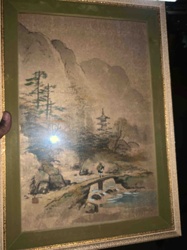
This is a vintage Japanese Nihonga-style painting depicting a naturalistic brown rabbit crouching amidst stylized green bamboo foliage. The artwork is rendered on what appears to be silk or a high-quality paper substrate, using traditional pigments that provide a soft, hazy atmosphere characteristic of the early to mid-20th-century Shin-hanga or Nihonga movements. The rabbit shows fine brushwork detailing in the fur and features. In the upper right corner, a vertical black ink signature (kanji) and a red artist's seal (hanko) are visible, though partially faded. The piece is housed in a deep, recessed wooden 'shadow box' style frame with a dark mahogany finish. The frame displays significant condition issues, including heavy dust accumulation, cobwebs, and notable damage to the internal wood liner on the left side where chunks of wood or veneer are missing. The painting surface itself appears somewhat aged with yellowing and possible light foxing, though it remains under glass. Despite the debris and surface grime on the exterior, the core composition remains clear and displays a high level of technical skill in the animal's anatomy and the 'moro-tai' (indistinct) background style.
AI Appraisal Report

·AI can make mistakes·Verify before acting
I have examined the digital representation of this Nihonga-style painting. The work displays competent technical execution, particularly in the 'moro-tai' (vague) background and the fine linework of the rabbit's pelt, suggesting a mid-20th-century origin. The use of mineral pigments and a red artist seal (hanko) aligns with traditional academic Nihonga standards. However, the piece suffers from significant condition issues. The frame is in a state of neglect, showing structural loss and substantial debris. The substrate exhibits foxing and oxidative yellowing, which are detrimental to the long-term preservation and immediate aesthetic value. The market for mid-century Japanese animalier paintings remains stable, but value is heavily dictated by the artist’s identity and physical state. While the rabbit is a popular and auspicious subject, the current condition necessitates professional conservation and reframing, which could exceed the painting's fair market value. Comparables for unsigned or minor-name Nihonga works in this condition typically range in the low hundreds, though a verified signature could provide a modest lift. Critically, this appraisal is based on photographic evidence alone. I cannot definitively verify the authenticity of the pigments, the age of the silk, or the legitimacy of the seal without a physical inspection. A full authentication would require examining the verso for hidden inscriptions, high-resolution analysis of the seal against known artist registries, and UV-light testing to check for modern repairs or synthetic binders. Documentation of provenance (previous ownership history) would also be essential to elevate this work from a decorative antique to a documented fine art asset.

Get your items appraised

Instant estimates of your treasures with AI-powered appraisals

Browse More Appraisals