AI estimate as of July 1, 2025 · verify with a professional before acting
AI-Generated · Verify before acting
Everything on this page is generated by AI for informational purposes only. AI can make mistakes — the AI may misidentify items or misattribute them (artist, maker, brand, designer, origin, era). This is not an official valuation and should not be used for insurance, sale, tax, estate, legal, or lending purposes — or any decision requiring a certified appraisal. It is not an authoritative claim about any person, brand, or rights holder — do not share or rely on it as a factual statement about a third party. Always consult qualified professionals before making financial decisions.
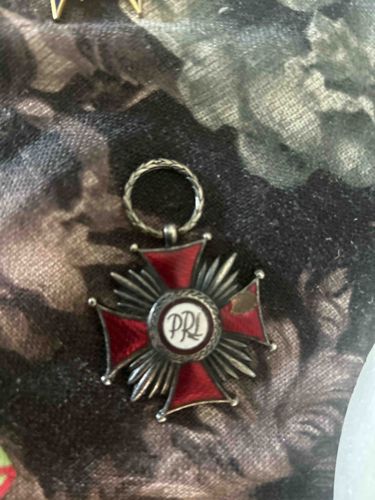
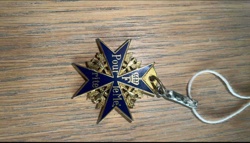
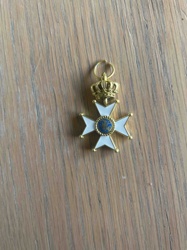
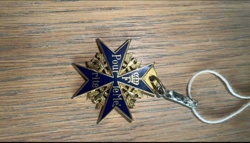
This item is a medal or insignia from the Polish People's Republic (PRL), specifically identified by the "PRL" initials prominently displayed within its central medallion. It is an enamelled and metal cross, characteristic of state orders. The primary material appears to be a silver-toned metal, possibly silver, silver-plated base metal, or a nickel alloy, forming the structure and the radiant rays emanating from the center. The cross itself features four main arms, each filled with a vibrant red enamel. These arms are bordered by the silver-toned metal, lending a crisp definition to the design. From the central circular medallion, a starburst pattern of approximately eight pointed rays radiates outwards between the arms of the cross. The central medallion is circular with a white enamel background, surrounded by a metal ring. Within this white field, the black capital letters "PRL" (Polska Rzeczpospolita Ludowa) are clearly inscribed. At the top, a decoratively textured bail, possibly with a braided or twisted design, is attached to the cross via a smaller, smooth loop, indicating its intended use for suspension from a ribbon (not present) or pin.
Regarding its condition, the most notable issue is significant enamel loss on the upper-right arm of the cross, where a large chip reveals the underlying metal. Smaller scuffs or scratches may also be present on the other enamel sections, typical of age and handling. The metal components show some signs of wear and possibly light tarnishing or patina, consistent with an object of its age. There are no visible manufacturer's marks, hallmarks, or engraver's signatures discernible from the provided image. The design strongly suggests it is a variant of the Order of Polonia Restituta (Order Odrodzenia Polski), specifically issued during the Polish People's Republic period (1944/1952-1989). Its craftsmanship, despite the enamel damage, appears to be of standard quality for such state awards, indicating systematic production. The precise class (e.g., Commander, Officer, Knight) cannot be determined without knowing its size or the ribbon it would have been suspended from, but the design is consistent with the lower classes (III Class Commander Cross or IV Class Officer Cross) which were worn from the neck or chest.
AI Appraisal Report
I have thoroughly examined the provided image of what appears to be an Order of Polonia Restituta from the Polish People's Republic (PRL) era. The design, particularly the 'PRL' inscription in the central medallion and the overall form, is consistent with known examples of this important Polish state order issued during 1944/1952-1989.
From a visual examination, the authenticity of the piece during the specified era is highly probable based on design fidelity. However, the condition presents a significant issue: there is noteworthy enamel loss on the upper-right arm of the cross, exposing the underlying metal. Other minor scuffs and a general patina are also present, consistent with age and handling. The absence of a ribbon, which often helps in classifying the exact grade, also impacts its completeness.
Regarding market conditions, PRL-era orders, while historically significant, are generally less rare and thus less valuable than their pre-war counterparts. They are regularly available on specialized militaria and phaleristics markets, online auctions, and collector shows. Demand for lower-class, common PRL issues is moderate, driven primarily by collectors seeking a representative example rather than pristine condition.
The significant enamel damage is the primary factor negatively impacting its value. A perfect or near-perfect example of this class would command a higher price. Without any visible maker's marks or provenance, it's considered a standard issue. Rarity is low for this specific type of order compared to other periods.
It is important to note the limitations of image-based appraisal. A definitive assessment of material composition (e.g., silver content), precise identification of any faint maker's marks, and a thorough evaluation of the extent of wear and damage would require in-person inspection. Establishing provenance, while difficult for such items, would also add value.