AI estimate as of October 17, 2025 · verify with a professional before acting
AI-Generated · Verify before acting
Everything on this page is generated by AI for informational purposes only. AI can make mistakes — the AI may misidentify items or misattribute them (artist, maker, brand, designer, origin, era). This is not an official valuation and should not be used for insurance, sale, tax, estate, legal, or lending purposes — or any decision requiring a certified appraisal. It is not an authoritative claim about any person, brand, or rights holder — do not share or rely on it as a factual statement about a third party. Always consult qualified professionals before making financial decisions.
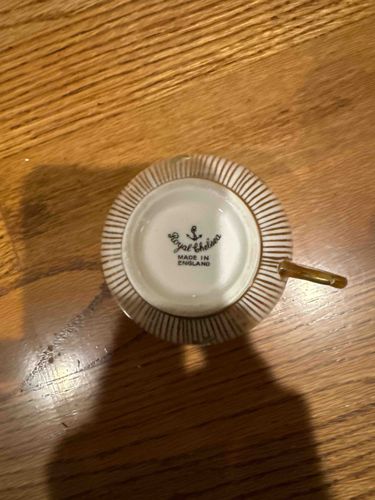
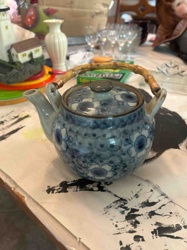
This item is a single porcelain teacup, viewed from an overhead perspective, showcasing its base and the interior of the cup. The cup features a delicate, slightly flared rim and a small, elegant handle, visible on the right side of the image, appearing to be gilded or a brass-like color. The dominant pattern on the exterior of the cup consists of fine, uniform vertical stripes in a dark color, possibly brown, gold, or black, against a lighter, possibly white or cream-colored, porcelain body. These stripes extend from the base upwards towards the rim. The base of the cup is a smooth, unadorned white or cream, centering a circular maker's mark. The mark clearly reads "Royal Chelsea" in a stylized script, accompanied by a small anchor icon, and below that, "MADE IN ENGLAND" in a more standard font. The overall construction suggests fine china or bone china, indicating a higher quality of ceramic. While the overall condition appears good from this angle, without a full view, it's difficult to ascertain any specific chips, cracks, or extensive wear. However, the gilding on the handle, if present, might show some minor rubbing consistent with age and use. The craftsmanship, particularly the detailed linear pattern and legible maker's mark, points to a well-made, possibly mid-20th century, collectible piece. The 'Royal Chelsea' mark is associated with the New Chelsea Porcelain Co. Ltd., typically producing fine bone china in England.
AI Appraisal Report
Upon examining the provided image of this porcelain teacup, I have identified it as a product of Royal Chelsea, as indicated by the clear maker's mark on the base featuring the anchor icon and the text 'MADE IN ENGLAND'. The mark is consistent with those used by the New Chelsea Porcelain Co. Ltd., suggesting an authentic piece likely from the mid-20th century. The pattern consists of fine vertical stripes, and the handle appears to be gilded. From the overhead view, the cup appears to be in good condition, with no visible cracks, chips, or significant crazing.
The market for individual teacups, even from reputable English makers like Royal Chelsea, is generally modest unless the pattern is particularly rare or sought after. The value is highest for a complete trio (cup, saucer, and tea plate). As a standalone teacup, its primary value is to someone seeking to complete a set or as a replacement piece. Comparable Royal Chelsea single teacups in common patterns typically sell for between $15 and $25 online and at antique markets. The value is significantly impacted by the absence of its matching saucer. Rarity is moderate; while Royal Chelsea is a collectible name, this striped pattern is not among their most famous or rare designs.
It is important to note the limitations of this appraisal, as it is based solely on a single image. A full, in-person examination would be necessary to confirm the absence of hairline cracks, assess the extent of wear on the gilding, and check for any repairs or restoration not visible in the photograph. Full authentication can only be achieved through physical inspection to verify the tactile qualities of the porcelain and the application of the mark and pattern.