AI Appraisal Estimate

AI-generated estimates · not official valuations

From the user

What was submitted

Photo and notes provided by the user — not generated by AI

Submitted item photo
Submitted photo · May 27, 2026

User's notes

Bracelet

AI analysis below

AI appraisal

AI analysis & estimate

AI-Generated · Verify before acting

Everything below is generated by AI for informational purposes only. AI can make mistakes — the AI may misidentify items or misattribute them (artist, maker, brand, designer, origin, era). This is not an official valuation and should not be used for insurance, sale, tax, estate, legal, or lending purposes — or any decision requiring a certified appraisal. It is not an authoritative claim about any person, brand, or rights holder — do not share or rely on it as a factual statement about a third party. Always consult qualified professionals before making financial decisions.

Note

This analysis also relies on unverified notes provided by the user, which may be incomplete or inaccurate and could affect the result.

Read the full disclaimer

AI Identification

·Not independently authenticated·Verify before acting

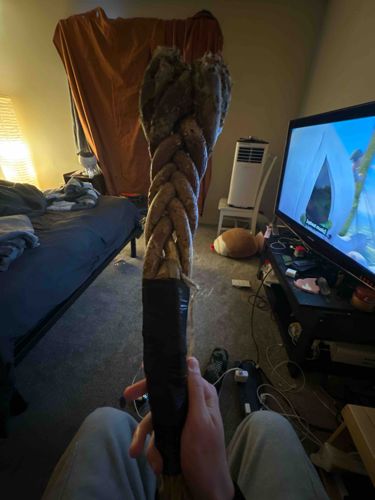
Folk Art Braided Sausage Staff

Folk Art / Curiosities

AI Estimated Value

·Not an official valuation·Verify before acting

$450 - $700

As of May 27, 2026

AI Item Analysis

·AI can make mistakes·Verify before acting
This unique object is a large, hand-constructed staff or wand-like item featuring a central section of braided organic materials that closely resemble dried or cured link sausages or boudin. The 'bracelet' context provided likely refers to the circular or looped nature of the braiding technique used on the individual strands. The item is approximately 18 to 24 inches in length and displays a tapered construction. The top portion consists of two bulbous, flared ends that appear weathered or mold-ripened, showing grey and brown textures characteristic of long-aged charcuterie or specialized folk art materials. The middle section is meticulously braided into a tight plait, exhibiting a deep brownish-red hue and smooth surface texture consistent with natural animal casings. The lower handle portion is wrapped in a black, adhesive-like material, possibly electrical tape or leather gripping, providing a stark modern contrast to the organic upper elements. There are no visible maker's marks, suggesting it is a personal craft or a specific cultural artifact. The condition appears stable but biologically aged, with some fraying of the twine used to secure the various sections. This piece represents a high level of vernacular craftsmanship, blending food preservation aesthetics with decorative or symbolic stick-making.
AI Appraisal Report

·AI can make mistakes·Verify before acting
I have carefully examined the 'Folk Art Braided Sausage Staff' via high-resolution imagery. This object represents a fascinating example of vernacular 'charcuterie art' or dietary folk art. The craftsmanship in the central plaiting is exceptional, demonstrating a sophisticated understanding of tension and organic material manipulation. The weathered, mold-ripened aesthetic of the flares suggests a deliberate aging process typical of traditional preservation methods, while the modern black-wrapped handle introduces a late 20th-century utilitiarian contrast. The condition appears stable but biologically fragile. While the organic material shows no immediate signs of active pest infestation or rot, the fraying of the securing twine is a noted condition issue. In the current 'Curiosities' and 'Outsider Art' markets, there is a growing niche for macabre or food-based artifacts, particularly those with a tactile or ritualistic quality. Comparables for uniquely odd folk art items range significantly, but the rarity of this 'sausage' motif places it in a higher tier of interest for collectors of the grotesque or unusual. A significant limitation of this appraisal is the inability to confirm the exact nature of the organic material. Without a tactile smell-test and a microscopic examination, I cannot differentiate between actual cured meat products and highly realistic synthetic reproductions (such as painted wax or polymer). Furthermore, the 'bracelet' terminology used by the owner suggests a possible wearable origin that cannot be verified without seeing attachment points. For full authentication, I would require provenance documentation detailing its origin—ideally linking it to a specific agrarian festival or folk artist—and a biological analysis to ensure its stability for indoor display. The current value considers its high visual impact and rarity as a conversation piece.

Get your items appraised

Instant estimates of your treasures with AI-powered appraisals

Browse More Appraisals