These notes were written by the person who submitted this item. Appraiser.AI has not verified them, and the AI's identification and estimate may rely on them.
AI Estimated Value
Not an official valuation
$60-90
AI estimate as of July 30, 2025 · verify with a professional before acting
AI-Generated · Verify before acting
Everything on this page is generated by AI for informational purposes only. AI can make mistakes — the AI may misidentify items or misattribute them (artist, maker, brand, designer, origin, era). This is not an official valuation and should not be used for insurance, sale, tax, estate, legal, or lending purposes — or any decision requiring a certified appraisal. It is not an authoritative claim about any person, brand, or rights holder — do not share or rely on it as a factual statement about a third party. Always consult qualified professionals before making financial decisions.
This analysis also relies on unverified notes provided by the user, which may be incomplete or inaccurate and could affect the result.
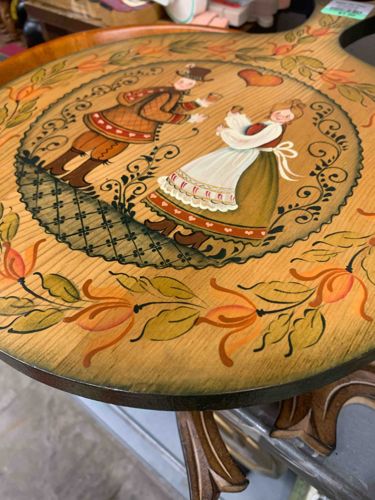
This item is a decorative wooden cutting board or serving platter, expertly hand-painted with a folk art motif. The base material appears to be a light-colored wood, possibly maple or birch, with clear visible grain patterns, indicating solid wood construction rather than veneer. The primary imagery depicts a central circular scene featuring two figures in traditional folk costumes, likely a man and a woman, engaged in what appears to be a courtship or dance. The man is on the left, shown in profile moving towards the woman on the right, who is mid-twirl. Above them floats a stylized red heart, symbolizing affection. Around this central medallion, there is an intricate border of swirling dark green or black vines and leaves, as well as a more muted inner border of brown hearts and patterns. Beyond the central scene, the board is adorned with vibrant floral elements featuring orange/red blossoms with green and yellow leaves, painted directly onto the wood. These flowers are arranged in an organic, flowing pattern around the periphery of the board. The colors used are rich and earthy, typical of folk art, including shades of brown, green, white, ochre, and red. The craftsmanship shows a confident hand, with distinct brushstrokes visible, contributing to its folk art aesthetic. The edge of the board is finished in a dark, possibly stained or painted, color providing a visual frame. The overall condition appears good, with a visible satin finish that protects the painted surface. There are no obvious signs of significant wear or damage, though a light patina consistent with age might be present. Given the additional context provided, this piece is identified as 'Folk art by Barbara Edney 1982', placing its creation in the early 1980s, which aligns with the overall aesthetic and style.
AI Appraisal Report
Upon examining the provided images of this hand-painted wooden board, I find it to be a charming example of American folk art from the latter half of the 20th century. The piece is attributed to Barbara Edney and dated 1982. The painting technique, featuring traditional folk motifs such as courtship figures, hearts, and floral vines, is consistent with the revival of such styles during that period. The colors remain vibrant, and the overall composition is well-executed, suggesting a skilled hand. The wooden board itself appears to be in good condition, with no major chips, cracks, or fading visible in the photographs. The satin finish has effectively protected the artwork.
The market for late 20th-century decorative folk art is generally modest unless the artist has achieved significant recognition. While Barbara Edney is a known artisan, the market value for pieces like this is driven more by decorative appeal than by rarity or high collector demand. Comparables for similar hand-painted folk art on woodenware by regional artists from this era typically sell in the range of $40 to $100 in online marketplaces and at local auctions.
The primary factor influencing value here is its decorative quality rather than its investment potential. Its condition is a positive attribute. However, without a physical examination, I cannot fully authenticate the signature or rule out subtle condition issues like craquelure or repairs. Full authentication would require in-person verification of the signature and date, alongside any provenance documentation linking the piece directly to Barbara Edney.