AI estimate as of July 13, 2025 · verify with a professional before acting
AI-Generated · Verify before acting
Everything on this page is generated by AI for informational purposes only. AI can make mistakes — the AI may misidentify items or misattribute them (artist, maker, brand, designer, origin, era). This is not an official valuation and should not be used for insurance, sale, tax, estate, legal, or lending purposes — or any decision requiring a certified appraisal. It is not an authoritative claim about any person, brand, or rights holder — do not share or rely on it as a factual statement about a third party. Always consult qualified professionals before making financial decisions.
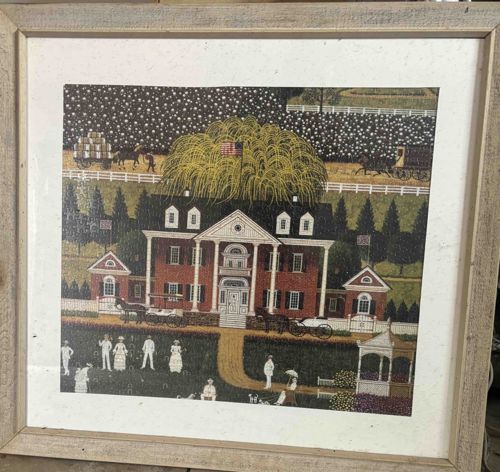
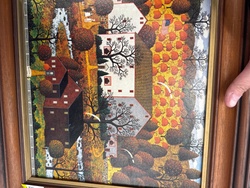
This item is a framed print or painting depicting a detailed folk art scene of a grand, red-brick house, likely a plantation or large estate, set within a lush landscape. The house features prominent white columns, multiple windows, and a central entryway, characteristic of Southern architectural styles, possibly Georgian or Federal. Two smaller outbuildings or wings flank the main structure. Below the house, a landscaped lawn is populated with numerous figures, dressed in period attire, engaged in various leisure activities, suggesting a social gathering. A winding path leads from the house's entrance. To the right, a white gazebo stands amidst purple flowers. Carriages and horses are depicted both near the house and in the background, where a field of white, possibly cotton or snow, stretches under a dark, star-filled sky. A large, weeping willow tree with vibrant yellow-green foliage dominates the foreground, partially obscuring the house, and an American flag is visible flying from a pole within its branches. Another small American flag is seen near one of the side buildings. The artwork exhibits a detailed, somewhat flat, and stylized perspective typical of folk art. The colors are rich and vibrant, with a notable contrast between the deep reds, greens, and the bright white accents. The texture of the print or painting appears slightly stippled or grainy, giving it a tactile quality. The item is housed within a simple, light-colored wooden frame with a distressed or whitewashed finish, showing minor wear and possibly some scuff marks, consistent with age or handling. The white mat surrounding the artwork shows some discoloration and specks, suggesting it could be an older piece or that it has been exposed to dust or moisture over time. There are no immediately discernible artist signatures or maker's marks visible in the provided images, which could be located beneath the mat or on the reverse. The overall impression is one of nostalgic Americana or a historical snapshot, rendered in a charming, naive style.
AI Appraisal Report
I have examined the provided image of this framed folk art estate scene. Based on visual assessment, the print or painting depicts a vibrant, detailed scene characteristic of 20th-century folk art. The condition appears good overall for its age, though the frame shows minor wear and the matting exhibits discoloration and speckling, suggesting age or environmental exposure. These are minor condition issues that slightly impact market perception but do not fundamentally detract from the artwork itself.
Authenticity is difficult to definitively confirm from images alone. While it presents as a genuine folk art piece, verification of the medium (print vs. original painting) and artist would require in-person examination. An original painting would command a significantly higher value than a print. I would need to physically inspect the work for brushstrokes, paper type, and any hidden signatures or edition numbers beneath the mat. Provenance documentation, such as artist information, exhibition history, or prior sales records, would be crucial for establishing authenticity and artist attribution, which directly influences value. Without a known artist, the piece is valued as a decorative folk art item.
The demand for charming, naive folk art scenes remains consistent, particularly those depicting American historical or pastoral themes. While not exceptionally rare as a genre, individual pieces vary. This particular scene, with its detailed depiction of an estate, figures, and elements like the American flags, adds to its appeal. Comparables in the unauthenticated folk art market typically range based on size, complexity, and condition. An original, unidentified folk art painting of this quality and subject matter could fetch higher, but as a likely print, its value is more modest.
Key factors impacting value are the unknown artist and the medium. If it were authenticated as an original painting by a recognized folk artist, the value would increase substantially. As a print or an unsigned, unprovenanced painting, its value is primarily decorative and secondary market driven. Full authentication requires physical inspection, and potentially provenance research or scientific analysis of the pigments/paper.