AI estimate as of August 27, 2025 · verify with a professional before acting
AI-Generated · Verify before acting
Everything on this page is generated by AI for informational purposes only. AI can make mistakes — the AI may misidentify items or misattribute them (artist, maker, brand, designer, origin, era). This is not an official valuation and should not be used for insurance, sale, tax, estate, legal, or lending purposes — or any decision requiring a certified appraisal. It is not an authoritative claim about any person, brand, or rights holder — do not share or rely on it as a factual statement about a third party. Always consult qualified professionals before making financial decisions.
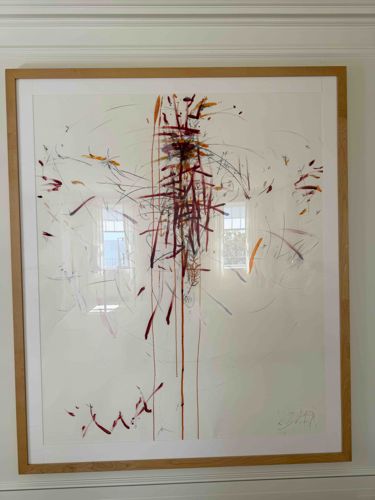
This appears to be a large, square-format abstract art print, framed under glass with a light-colored wooden frame and a white mat. The artwork itself features a central vertical axis composed of numerous intersecting lines and strokes, predominantly in shades of deep red, maroon, and burnt orange, suggestive of a dense, organic form or concentrated energy. Complementing these central elements are lighter, more scattered strokes and drips in similar hues, as well as some lighter grey or black lines, extending outwards from the core. The distribution of marks includes both sharp, angular strokes and longer, more fluid drips, creating a dynamic sense of movement. There are some circular or swirling elements noticeable around the central vertical mass. The medium appears to be some form of ink or paint, possibly a monoprint or a screen print, given the consistent pigment and stroke quality. The background is a stark, clean white, which effectively highlights the vibrant colors of the artwork. A signature or marking is visible in the lower right corner, appearing to be in the same red/maroon pigment as some of the artwork's strokes, which could indicate the artist's signature or edition number. The print is in excellent visible condition; the mat appears clean, and the frame shows no obvious signs of wear or damage. The reflective surface of the glass indicates it is likely plain glass, not anti-reflective. The style is distinctly abstract expressionist or gestural, suggesting a contemporary period, likely late 20th or early 21st century. The overall craftsmanship of the framing seems professional and of good quality, with neat corners and appropriate proportions for the artwork.
AI Appraisal Report
Based on my examination of the provided image of the framed abstract art print, I assess its condition to be excellent. The print itself shows no visible damage, the mat is clean, and the frame appears robust with neat corners. The reflective surface indicates standard glass, not anti-reflective, which is common. The style is clearly Abstract Expressionist or gestural, aligning it with late 20th to early 21st-century artistic trends.
From the image alone, authenticity verification is limited. The visible signature/marking in the lower right, appearing in the same pigment as the artwork’s strokes, suggests it's integrated with the piece. However, without in-person examination, comparing it to known authentic signatures of potential artists, or provenance documentation (e.g., certificate of authenticity, gallery receipts, exhibition history), I cannot definitively confirm its authenticity or attributed artist. Scientific testing of the medium would also be beneficial for dating and material analysis.
In terms of market conditions, the demand for accessible, decorative abstract art is generally stable, especially for pieces that are well-framed and in good condition. While this piece possesses dynamic energy and good color, its specific artist and original medium (print type) remain unconfirmed. Without an established artist or edition information, it falls into a broader category of decorative art rather than fine art with collectible value. Comps would include similar-sized, framed abstract prints from unlisted or emerging artists sold through online platforms or local galleries.
The main factors impacting value are the unknown artist, specific print medium (e.g., original monoprint vs. reproduction print), and a lack of provenance. Should further investigation reveal an identifiable, listed artist or rare print type, the value could significantly increase. Until then, its value is primarily as a well-presented decorative piece.
For a full authentication, physical inspection would be crucial to examine print quality, paper type, and artist's mark details. Provenance documents are essential for tracing ownership history and confirming authenticity.