AI estimate as of October 13, 2025 · verify with a professional before acting
AI-Generated · Verify before acting
Everything on this page is generated by AI for informational purposes only. AI can make mistakes — the AI may misidentify items or misattribute them (artist, maker, brand, designer, origin, era). This is not an official valuation and should not be used for insurance, sale, tax, estate, legal, or lending purposes — or any decision requiring a certified appraisal. It is not an authoritative claim about any person, brand, or rights holder — do not share or rely on it as a factual statement about a third party. Always consult qualified professionals before making financial decisions.
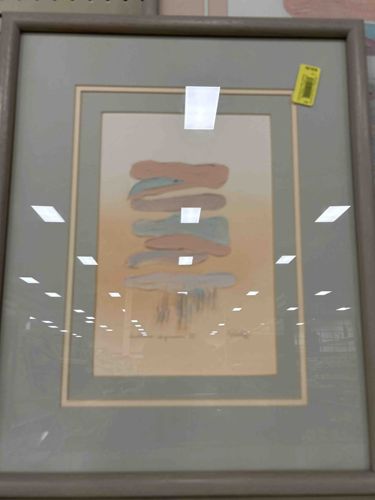
This item is a framed piece of abstract wall art, likely a print, characterized by a series of stacked, organic shapes in muted pastel colors. The central image features several horizontal, cloud-like or pebble-like forms, predominantly in soft peach/light terracotta and muted teal/light blue hues. These shapes are unevenly stacked, suggesting a sense of precarious balance or natural arrangement, such as cairns. Below these main forms, there appear to be smaller, vertical brushstrokes or drips in a darker, possibly blue-grey color, giving the impression of rain or streaking. The background is a soft, warm neutral tone, possibly an off-white or very light beige that subtly fades. The artwork is professionally matted with a wide, light grey-green matboard, which frames the central image and provides a significant border. A thin, possibly gold or light natural wood-toned fillet or inner frame separates the mat from the artwork. The overall frame is a simple, flat profile made of wood or a wood-like material, colored in a slightly darker taupe or grey-brown. The frame's finish appears slightly distressed or matte. The piece is covered with a clear protective sheet, likely glass or acrylic, which exhibits multiple reflections from overhead lighting and some glare. A yellow price tag or sticker is visible in the upper right corner of the frame. While specific artist details are not clearly visible due to reflections and image quality, there appears to be faint text or a signature in the lower central part of the print. The style suggests a contemporary or modern aesthetic, potentially dating from the late 20th to early 21st century. The condition appears good overall, with no obvious major damage to the frame or artwork itself, though the protective cover shows some superficial marks and reflections. The craftsmanship of the framing seems decent, indicating it was intended as finished wall decor.
AI Appraisal Report
I have examined the provided image of this framed abstract wall art print. The condition appears to be good overall, with no obvious damage to the print or major defects on the frame, though the protective cover shows reflections and superficial marks. Authenticity of the artwork itself, beyond being a print, cannot be fully verified from images alone. The faint text in the lower central part could be a signature or edition number, but this requires in-person inspection. Without handling the piece, I cannot determine if it's an inkjet print, a lithograph, or another printmaking technique. I also cannot verify if the 'distressed' finish on the frame is intentional or reflects wear.
Market conditions for contemporary decorative prints are generally robust for mass-produced items, but individual artist works vary greatly. This piece appears to be a decorative print, possibly from a mass-market retailer, given the professional but somewhat generic framing. Demand for abstract art remains steady, particularly pieces with muted, calming color palettes like this one. However, rarity is low for prints unless they are limited editions by a recognized artist, which I cannot confirm. Factors impacting value include the print type, the actual artist's recognition, and whether it's an open or limited edition. The visible price tag suggests a retail history, but its context is unknown.
Limitations in authenticity verification are significant. A physical examination for signs of editioning (pencil signature, edition number), print quality, and paper type is essential. Provenance documentation (purchase receipts, artist's certificate of authenticity) would be crucial for establishing its origin and potential value if it were an artist's original print. Without these, it is appraised as a decorative print.