AI estimate as of August 22, 2025 · verify with a professional before acting
AI-Generated · Verify before acting
Everything on this page is generated by AI for informational purposes only. AI can make mistakes — the AI may misidentify items or misattribute them (artist, maker, brand, designer, origin, era). This is not an official valuation and should not be used for insurance, sale, tax, estate, legal, or lending purposes — or any decision requiring a certified appraisal. It is not an authoritative claim about any person, brand, or rights holder — do not share or rely on it as a factual statement about a third party. Always consult qualified professionals before making financial decisions.
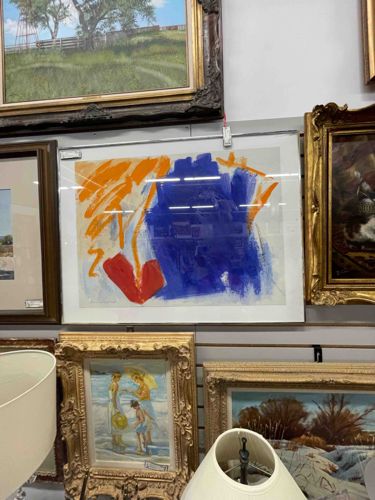
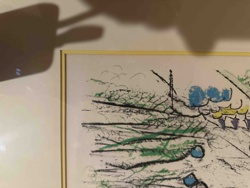
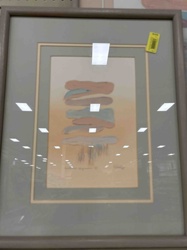
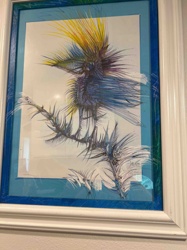
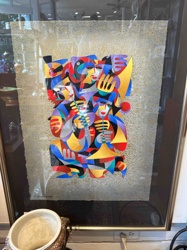
This item is a framed abstract art print, likely a lithograph or serigraph, characterized by bold, expressive brushstrokes and a vibrant color palette. The dominant colors in the composition are a deep, intense blue forming a large, somewhat rectangular or amorphous shape towards the right, and bright, energetic orange strokes appearing to emanate from the upper left and extending across the top. A distinct heart-like shape rendered in a vivid red is situated in the lower-left quadrant, contrasting with the blue and orange. The artwork is presented under glass or acrylic glazing within a wide, simple white or off-white mat, which serves to provide ample negative space around the central image. The outer frame appears to be a thin, light-colored material, possibly wood or metal, consistent with a minimalist aesthetic that allows the artwork to be the primary focus. The print's surface indicates a textured quality, possibly from the printing process, or the original media it emulates. No visible artist's signature, edition number, or specific manufacturing marks are apparent from the provided image. The overall style suggests a mid-to-late 20th century abstract expressionist or post-modern influence. The condition appears good, with no obvious tears, creases, or significant discoloration to the print. The glazing reflects overhead lighting, indicating it is clean and intact. The frame seems free of major dents or scratches. The simplicity of the framing suggests a deliberate choice to highlight the modern abstract nature of the piece.
AI Appraisal Report
Upon my virtual examination of this abstract art print, likely a lithograph or serigraph, I find its condition to be good. There are no readily apparent tears, creases, or significant discoloration. The simple, light-colored frame and wide white mat complement the artwork, maintaining a minimalist aesthetic that highlights the abstract form. Authenticity, based solely on visual inspection of images, is a significant limitation. While the style strongly evokes mid-to-late 20th-century Abstract Expressionism, without a visible signature, edition numbers, or artist's chop marks, I cannot definitively attribute it to a specific artist or confirm its originality beyond being a print. Market conditions for unsigned abstract prints are generally moderate unless provenance links them to a known artist. Comparables in this category would typically include decorative abstract prints from the period, sometimes sold in gallery settings or online marketplaces. Demand for such pieces is steady among those seeking aesthetically pleasing, colorful abstract art for interior decoration. Rarity is difficult to ascertain without knowing the print run or artist. Factors significantly impacting value include the unknown artist, lack of signature, and the fact that it is a print, rather than an original painting. For full authentication, an in-person examination is crucial to assess paper quality, printing technique, and any hidden marks. Provenance documentation, connecting the piece to an artist or publisher, would be paramount. Scientific testing, like pigment analysis where applicable, could also provide insights into its age and materials. Without these, the value remains in its decorative merit rather than its fine art investment potential.