AI Appraisal Estimate

AI-generated estimates · not official valuations

From the user

What was submitted

Photo and notes provided by the user — not generated by AI

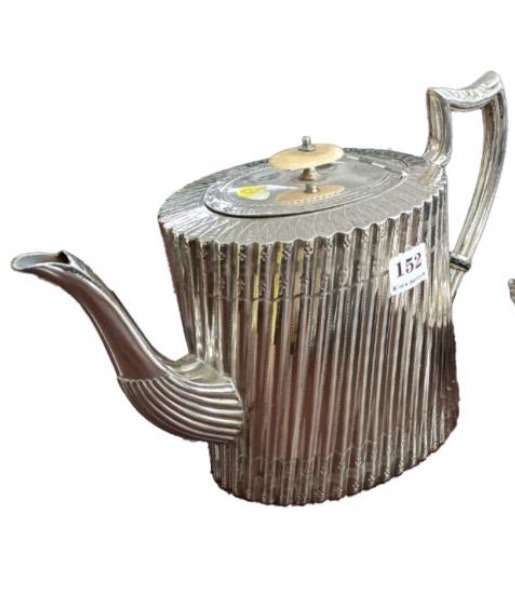
Submitted item photo
Submitted photo · June 25, 2026

User's notes

No additional notes provided.

AI analysis below

AI appraisal

AI analysis & estimate

AI-Generated · Verify before acting

Everything below is generated by AI for informational purposes only. AI can make mistakes — the AI may misidentify items or misattribute them (artist, maker, brand, designer, origin, era). This is not an official valuation and should not be used for insurance, sale, tax, estate, legal, or lending purposes — or any decision requiring a certified appraisal. It is not an authoritative claim about any person, brand, or rights holder — do not share or rely on it as a factual statement about a third party. Always consult qualified professionals before making financial decisions.

Read the full disclaimer

AI Identification

·Not independently authenticated·Verify before acting

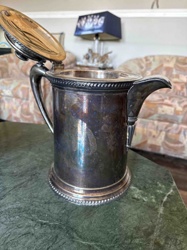
George III Sheffield Plate Fluted Teapot

Antique Silver & Silverplate

AI Estimated Value

·Not an official valuation·Verify before acting

$400 - $650

As of June 25, 2026

AI Item Analysis

·AI can make mistakes·Verify before acting
This is a Georgian-style teapot, likely George III period (circa 1790-1810), featuring a tall, oval cylindrical body constructed with upright fluting. The piece is crafted from silver-plated metal, likely Old Sheffield Plate, given the era's stylistic hallmarks. The exterior is characterized by tight vertical ribbing or gadrooning that extends around the entire circumference. It features a flush-mounted hinged lid with an oval bone or ivory finial and a corresponding heat-insulating spacer on the handle. The curved spout is decorated at the base with shell-like fluting to match the body aesthetic. The C-scroll handle is angular and tapered. Notable features include a decorative foliate or leaf-patterned border along the upper shoulder and lower base. Condition-wise, the silver plating shows signs of age-related wear, with visible tarnishing and some possible 'bleeding' where the underlying copper base metal may be surfacing through the silver. Small surface scratches and a lot sticker numbered '152' are present on the side. The overall craftsmanship is high, reflecting Neoclassical design influences prevalent in late 18th-century English holloware.
AI Appraisal Report

·AI can make mistakes·Verify before acting
I have examined the digital image of the George III Sheffield Plate fluted teapot. The item exhibits the elongated oval forms and vertical gadrooning characteristic of the Neoclassical period, approximately 1790–1805. The flush-mounted hinge and bone/ivory finial are consistent with high-quality English manufacturing of the era. Visually, the piece shows significant 'bleeding,' where the silver has worn to reveal the copper substrate. While collectors of Old Sheffield Plate often appreciate this 'warm' aesthetic, extensive wear to the silver layer generally caps the valuation compared to pristine examples. The market for Georgian silverplate remains stable but specialized. Demand is driven by the 'country house' aesthetic, though utilitarian use is limited by the age of the heat insulators. Comparables for similar Sheffield octagonal or fluted pots at auction typically fall within the sub-$700 range unless attributed to a specific maker like Matthew Boulton. Limitations of this appraisal include the inability to verify the integrity of the base metal, check for lead-solder repairs, or confirm the absence of pin-hole leaks. A physical inspection is required to search for a manufacturer's mark (often found on the base or under the handle) and to verify if the silvering is original or a later electroplated restoration. Provenance documentation would be necessary to elevate this piece from a decorative antique to a significant historical specimen.

Get your items appraised

Instant estimates of your treasures with AI-powered appraisals

Browse More Appraisals