AI estimate as of September 7, 2025 · verify with a professional before acting
AI-Generated · Verify before acting
Everything on this page is generated by AI for informational purposes only. AI can make mistakes — the AI may misidentify items or misattribute them (artist, maker, brand, designer, origin, era). This is not an official valuation and should not be used for insurance, sale, tax, estate, legal, or lending purposes — or any decision requiring a certified appraisal. It is not an authoritative claim about any person, brand, or rights holder — do not share or rely on it as a factual statement about a third party. Always consult qualified professionals before making financial decisions.
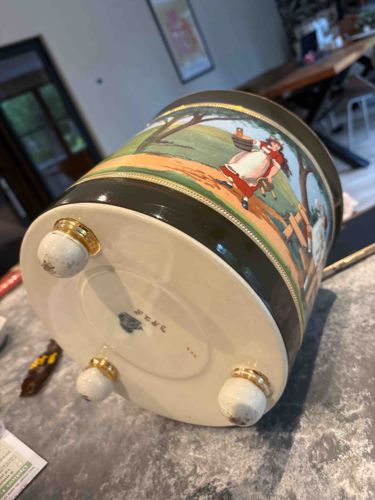
This item is a cylindrical jardiniere or planter, likely crafted from ceramic or porcelain, given its smooth, glazed appearance. It stands on three prominent ball-shaped feet, each adorned with a gilded ring at its base where it meets the body of the jardiniere. The main body of the piece features a dark, possibly olive-green or rich brown, textured field that frames a central decorative band. This band is predominantly cream or light tan in color, showcasing a pastoral scene with figures dressed in what appears to be traditional or historical European attire, surrounded by trees and a rustic fence. One notable figure is a woman in a red skirt and white apron carrying a basket, depicted in mid-stride. The top and bottom edges of this pictorial band are bordered by a thin, intricate gold design, suggesting a high level of decorative detail. The overall condition shows some visible wear, particularly on the white feet which appear scuffed and discolored, indicating age and use. The glaze on the body seems largely intact, though minor surface irregularities might be present but are not clearly discernible from the image. The underside of the jardiniere, visible in one of the images, is white and reveals what appears to be a manufacturer's mark, possibly a stamp in blue ink, along with some impressed numbers or letters, though these are too blurry to be precisely identified. The style, particularly the detailed scenes and color palette, suggests it could be Toulene ware or in the style of Mettlach pottery, dating possibly to the late 19th or early 20th century. The craftsmanship appears to be of good quality, typical of decorative ceramic wares from that era, designed for holding plants or as a decorative accent.
AI Appraisal Report
Based on my visual examination of the provided image, this jardiniere, stylistically aligned with Toulene ware or Mettlach pottery, appears to be a late 19th to early 20th-century decorative ceramic piece. Its condition shows notable wear, particularly the scuffed and discolored white feet, which detract from its overall presentation. The main body's glaze seems largely intact, though fine details of surface irregularities are not discernible from the image. The intricate gilded borders and pastoral scene suggest a higher quality of craftsmanship.
Authenticity verification from images alone is inherently limited. While the style is indicative, a definitive attribution to Toulene or Mettlach would require an in-person examination of the manufacturer's mark. The blurred nature of the visible mark prevents precise identification. Physical inspection would allow for tactile assessment of the ceramic body, glaze quality, and a clearer view of any impressed or stamped marks, which are crucial for authenticating the piece and determining its precise origin and maker. Without this, I cannot definitively confirm it is Mettlach or Toulene, and it remains 'Mettlach Style'.
Market conditions for 'Mettlach Style' garden wares typically fluctuate. Items with clear Mettlach provenance fetch higher prices. Comparables for similar decorative, unauthenticated European jardinieres in this condition generally fall within the $250-$400 range. Demand for such items is moderate among collectors of turn-of-the-century ceramics, but rarity is not exceptionally high unless it's a documented piece from a renowned workshop. The most significant factor impacting value here is the current ambiguity of its manufacturer and the visible wear.
To fully authenticate and maximize value, an in-person examination, professional cleaning, and potentially research into the legible portion of the manufacturer's mark would be advisable. Provenance documentation, if available, would also be invaluable.