AI estimate as of December 13, 2025 · verify with a professional before acting
AI-Generated · Verify before acting
Everything on this page is generated by AI for informational purposes only. AI can make mistakes — the AI may misidentify items or misattribute them (artist, maker, brand, designer, origin, era). This is not an official valuation and should not be used for insurance, sale, tax, estate, legal, or lending purposes — or any decision requiring a certified appraisal. It is not an authoritative claim about any person, brand, or rights holder — do not share or rely on it as a factual statement about a third party. Always consult qualified professionals before making financial decisions.
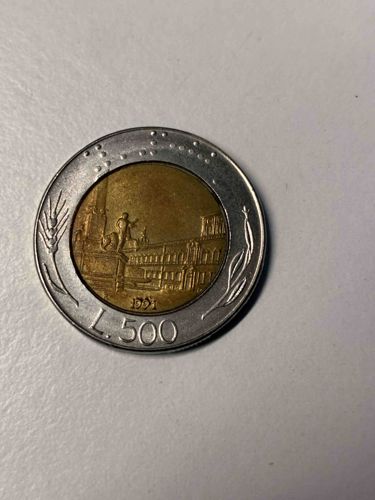
This item is an Italian 500 Lire bimetallic coin, visibly dated 1991. The coin features a distinct two-tone construction: a central golden-colored disc surrounded by a silver-colored outer ring. The obverse (the side pictured) displays a detailed scene within the golden core, featuring what appears to be a classical architectural structure, possibly the Colosseum or a similar ancient Roman building, alongside a standing figure, potentially an equestrian statue. The year '1991' is clearly engraved below the central design on the golden core. The outer silver-colored ring features decorative elements, including a laurel or olive branch design on the right side and what appears to be a wheat stalk or similar agricultural motif on the left. The denomination 'L. 500' is prominently inscribed in the silver ring at the bottom. The surface of both the golden core and the silver ring shows some signs of circulation and wear consistent with its age, including minor scratches, scuffs, and possibly some darkening or patina in recessed areas. The edges appear to be reeded or milled, a common feature for security and grip in coinage, although this is not perfectly clear from the image. The overall condition suggests it was a circulated coin but retains good detail in its designs. The craftsmanship is typical of modern coinage, with precise engraving and a clear separation between the bimetallic components. This coin represents a historical period in Italian currency before the adoption of the Euro.
AI Appraisal Report
I have examined the provided image of this Italian 500 Lire bimetallic coin, dated 1991. Based on visual inspection, the coin appears authentic, consistent with known examples of this issue. The bimetallic composition with a golden-colored core and silver-colored outer ring is clearly visible. The obverse detail, including the classical architectural structure (likely the Colosseum) and equestrian statue, along with the year '1991', aligns with the standard design for this coin. The decorative elements on the outer ring, such as the laurel/olive branch and wheat stalk, also match known specimens. The denomination 'L. 500' is clearly inscribed.
Regarding condition, the coin shows clear signs of circulation, including minor scratches, scuffs, and some darkening, consistent with its age and use. These wear marks suggest a circulated grade, likely Fine to Very Fine (F-VF) on the Sheldon scale, which is typical for common coinage of this era. This level of wear significantly impacts its numismatic value.
Market conditions for circulated Italian 500 Lire coins from 1991 are generally low. This specific issue is not considered rare; millions were minted, making it a common coin. While it holds historical significance as a pre-Euro currency, demand from collectors for circulated examples is modest. Most collectors seek uncirculated or proof examples for significant value. Therefore, the primary value for this piece is its face value in Italian Lira (now obsolete) or as a curiosity/souvenir.
Authenticity verification from images alone has limitations. While the visual details align, a definitive assessment would require physical examination to check for exact weight, diameter, thickness, and edge reeding details, which are crucial for ruling out sophisticated counterfeits. Microscopic examination could also confirm metallic composition and strike quality. However, given the common nature and low value of this particular coin in circulated condition, it is highly unlikely to be a counterfeit.