AI estimate as of October 27, 2025 · verify with a professional before acting
AI-Generated · Verify before acting
Everything on this page is generated by AI for informational purposes only. AI can make mistakes — the AI may misidentify items or misattribute them (artist, maker, brand, designer, origin, era). This is not an official valuation and should not be used for insurance, sale, tax, estate, legal, or lending purposes — or any decision requiring a certified appraisal. It is not an authoritative claim about any person, brand, or rights holder — do not share or rely on it as a factual statement about a third party. Always consult qualified professionals before making financial decisions.
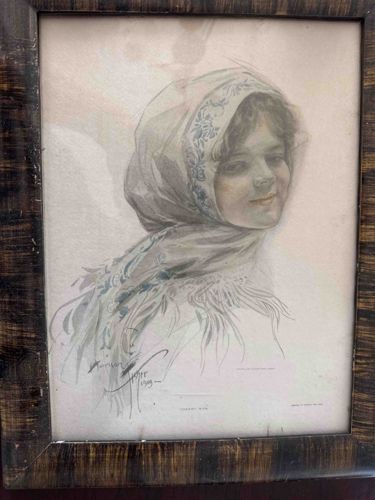
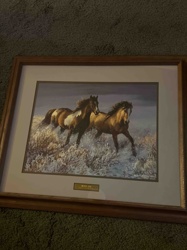
This item is a framed print depicting a young woman, likely a reproduction of a drawing or watercolor, titled 'Charity Wait'. The subject is a smiling woman with dark, curly hair, seen in a head-and-shoulders portrait, looking slightly towards the viewer's right. She is wearing a light-colored headscarf or shawl that features a delicate blue floral pattern along the border and a long, fringed wrap or shawl draped over her left shoulder, also adorned with similar blue floral motifs. The artwork itself appears to be a mixed media style, seemingly blending pencil or charcoal sketching with watercolor accents, particularly in the blues of the fabric and subtle coloring in her face. The background is largely unadorned, suggesting a focus on the subject. A discernible signature, 'Harrison Fisher', along with what appears to be the year '1909', is located in the lower left quadrant of the print. The title, 'CHARITY WAIT', is printed centrally below the image, and a 'MADE IN U.S.A.' or similar origin mark is visible in the lower right. The print is housed within a dark wooden frame with a distressed or rustic finish, characterized by visible grain and perhaps intentional wear or streaking that gives it an aged appearance. The frame's corners show some minor separation or gaps. The overall condition of the print appears fair to good for its age, though there might be some yellowing or discoloration of the paper consistent with historical prints. The visible frame wear indicates its age and use. The general aesthetic points to an early 20th-century style, typical of sentimental or romanticized portraits popular in that era.
AI Appraisal Report
I have examined the provided image of the framed print, 'Charity Wait' by Harrison Fisher. This appears to be a typical early 20th-century print reproduction of Fisher's work, dated 1909. The subject matter, a romanticized female portrait, was highly popular during this era.
The print itself seems to be in fair to good condition for its age, with potential for some yellowing or discoloration, which is common. The visible signature 'Harrison Fisher' and date '1909' are consistent with his published works. However, without direct inspection, I cannot verify if this is an authentic hand-signed piece or a printed signature; based on the typical production of such prints, it is likely a printed reproduction of his signature. The 'MADE IN U.S.A.' mark further supports its mass-produced nature.
The frame, a dark, distressed wood, complements the period aesthetic but shows minor separation at the corners, consistent with age and typical wear. This does not significantly detract from the value for this type of item.
Regarding market conditions, Harrison Fisher prints were widely disseminated and are not rare. There's a steady, but not particularly high, demand for framed prints from this period, especially reproductions. Comparable sales for similar framed Harrison Fisher prints typically fall within the $40-$120 range, depending heavily on condition, framing, and specific artwork popularity. Rare, signed, or artist-proofs would command significantly more, but this does not appear to be the case here.
Factors impacting value: The aesthetic appeal of the image, the condition of both print and frame, and the artist's enduring recognition contribute positively. However, its nature as a mass-produced print, rather than an original artwork or a limited-edition artist-signed piece, limits its top-end value.
Limitations: A full authentication would require in-person examination to differentiate between a printed signature and an actual hand signature, assess paper quality, detect any restoration, and verify print process (e.g., photogravure, halftone). Provenance documentation would also be crucial to confirm its history, but is unlikely for this type of item.