AI estimate as of August 7, 2025 · verify with a professional before acting
AI-Generated · Verify before acting
Everything on this page is generated by AI for informational purposes only. AI can make mistakes — the AI may misidentify items or misattribute them (artist, maker, brand, designer, origin, era). This is not an official valuation and should not be used for insurance, sale, tax, estate, legal, or lending purposes — or any decision requiring a certified appraisal. It is not an authoritative claim about any person, brand, or rights holder — do not share or rely on it as a factual statement about a third party. Always consult qualified professionals before making financial decisions.
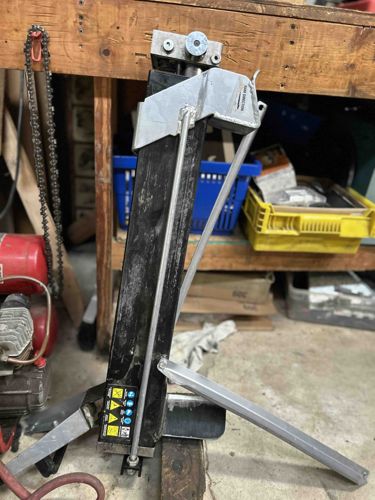
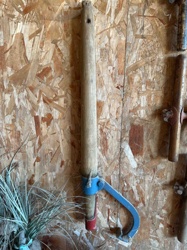
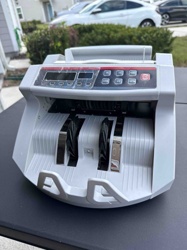
The item is a hydraulic or mechanical lift column, likely used for lifting heavy objects or as part of a larger system such as a vehicle lift or a component of a gantry crane. It features a predominantly black main column, which appears to be made of heavy-gauge steel, providing robust structural integrity. The column shows signs of wear, including scuffs and potential dust or grime accumulation, consistent with use in a workshop or industrial environment. Attached to the top section of the black column is a grey, possibly aluminum or painted steel, mounting bracket or headpiece. This bracket is secured with visible bolts and features a circular component, possibly a bearing or pivot point, for an attachment or rotational movement. A sticker or label with text, though illegible, is visible on this upper assembly, likely indicating warnings or manufacturing details. Running parallel to the main black column on one side is a slender, silver-colored rod or rail, which could be part of a guiding mechanism or a hydraulic line. Toward the bottom of the main column, there's a control panel or warning label patch with several yellow and blue icons, indicating various operational states or safety warnings (e.g., 'Do not block,' 'Pinch point,' 'Read manual'). At the base, there are sturdy, splayed outriggers or support arms made of a lighter silver-colored metal, extending outwards to provide stability. These arms are either fixed or foldable for compactness. One of these support arms is clearly visible extending to the lower right. The overall construction suggests a piece of durable, professional-grade equipment designed for significant load-bearing capacity. There are no clear manufacturer's marks or model numbers discernible from the image, making it difficult to pinpoint the exact brand or model. The age is estimated to be modern, likely within the last 20-30 years, given the industrial design and safety iconography. The visible condition suggests it is functional with typical signs of use but no obvious major damage or repairs.
AI Appraisal Report
I have examined the provided image of what appears to be a hydraulic or mechanical lift column, likely a component of a larger vehicle lift system. Visually, the item presents as a robust, industrial-grade piece of equipment. The predominantly black main column, presumably steel, shows expected signs of wear such as scuffs and dust, consistent with use in a shop environment. There are no indications of major structural damage, significant dents, or excessive corrosion, suggesting it remains functional. The grey mounting bracket and silver support arms appear intact. The safety labeling, though illegible in detail, confirms its engineered design for safety. Without clear manufacturer markings or model numbers, authenticating its specific brand or precise model is impossible from the image alone. An in-person inspection would be critical to assess the integrity of the hydraulic components (if applicable), the condition of internal workings, the functionality of the control panel, and any potential stress fractures not visible on the surface. Furthermore, provenance documentation detailing its service history, original purchase, and maintenance records would be essential for full authentication and to ascertain its true operational life and capacity. Comparative market analysis for used industrial lift components indicates a varied demand, largely dependent on specific capacity, brand reputation, and condition. Generic, unbranded components tend to fetch less. Given the visible condition and its apparent nature as a functional yet used piece of heavy equipment, and lacking comprehensive details vital for a precise valuation, I would place it in a moderate range for used industrial equipment.