AI estimate as of July 10, 2025 · verify with a professional before acting
AI-Generated · Verify before acting
Everything on this page is generated by AI for informational purposes only. AI can make mistakes — the AI may misidentify items or misattribute them (artist, maker, brand, designer, origin, era). This is not an official valuation and should not be used for insurance, sale, tax, estate, legal, or lending purposes — or any decision requiring a certified appraisal. It is not an authoritative claim about any person, brand, or rights holder — do not share or rely on it as a factual statement about a third party. Always consult qualified professionals before making financial decisions.
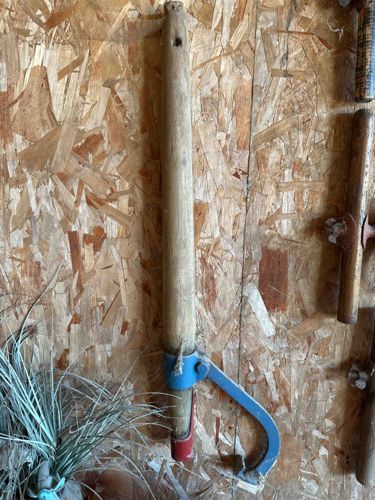
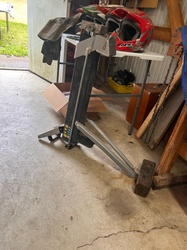
The item is a logging peavey, characterized by a long, rounded wooden handle and a metal 'hook' or 'dog' assembly attached near the bottom. The wooden handle appears to be made of a light-colored hardwood, possibly hickory or ash, given its common use in such tools for strength and durability. It has a visible grain and shows signs of wear consistent with use, including a dark patina and some surface abrasions. Near the top of the handle, there is a small, round hole, likely for hanging the tool or perhaps for an additional attachment. The metal components consist of a blue-painted 'dog' or hook that hinges from a blue-painted collar or bracket secured around the wooden handle. This blue paint shows significant chipping and wear, revealing the underlying metal. There is also a red-painted metal ferrule or band just below the blue collar, also showing paint loss. The 'dog' itself is a curved piece of metal with a pointed end, designed to bite into logs. Its surface appears to be a dull metallic gray where the paint has worn off, with some signs of rust or oxidation. The overall construction suggests a robust tool built for heavy-duty outdoor work. No specific maker's marks or signatures are visible. Based on its design and visible wear, it appears to be a functional, albeit used, logging tool from the mid to late 20th century. The quality of materials and craftsmanship seems appropriate for a utility tool, prioritizing function and durability over aesthetic refinement. The wood handle shows good integrity, suggesting quality wood, and the metalwork appears solid.
AI Appraisal Report
Based on my visual examination of the provided image, this logging peavey is a functional, used tool. The long, rounded wooden handle, likely hickory or ash, shows expected wear, including a dark patina and abrasions, consistent with mid to late 20th-century utility. The metal components, specifically the blue-painted 'dog' and collar, exhibit significant paint chipping and wear, revealing the underlying metal and some oxidation. A red-painted ferrule below the collar also shows paint loss. The 'dog' itself is a curved, pointed piece, designed for log handling, and appears sturdy. No maker's marks are visible, which is common for such utilitarian items, making definitive attribution difficult from images alone. The overall condition suggests a tool that has seen considerable use but remains structurally sound; its integrity is good for its age and purpose.
In terms of market conditions, logging peaveys are not rare but highly functional tools. The demand for vintage or antique versions is niche, typically among collectors of logging equipment, landscapers, or those seeking historical tools for practical use or display. Comparables on online marketplaces and at tool shows typically range from $40 to $100 for used, unmarked examples in similar condition. The absence of specific maker's marks or historical significance limits its collectible value beyond its utility. Factors impacting value negatively include the significant paint loss and general wear.
My appraisal is limited to visual inspection. For full authentication and to ascertain any hidden flaws or repairs, a physical in-person examination would be crucial. This would allow for tactile assessment of wood integrity, detailed inspection for metal fatigue or hidden welds, and microscopic analysis for potential maker's marks not visible in the image. Provenance documentation, such as the tool's history of ownership or use in a particular logging operation, would significantly enhance its historical value and, consequently, its market value, but this is not available here. Without such documentation or physical inspection, the value remains primarily based on its current condition as a functional antique tool.