AI Appraisal Estimate

AI-generated estimates · not official valuations

From the user

What was submitted

Photo and notes provided by the user — not generated by AI

Submitted item photo
Submitted photo · June 28, 2026

User's notes

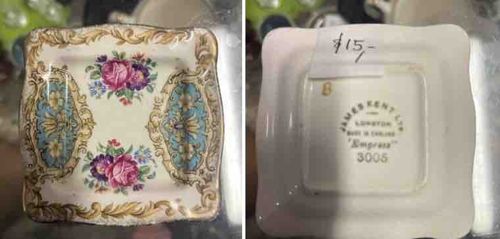
James Kent Longton EMPRESS 3005

AI analysis below

AI appraisal

AI analysis & estimate

AI-Generated · Verify before acting

Everything below is generated by AI for informational purposes only. AI can make mistakes — the AI may misidentify items or misattribute them (artist, maker, brand, designer, origin, era). This is not an official valuation and should not be used for insurance, sale, tax, estate, legal, or lending purposes — or any decision requiring a certified appraisal. It is not an authoritative claim about any person, brand, or rights holder — do not share or rely on it as a factual statement about a third party. Always consult qualified professionals before making financial decisions.

Note

This analysis also relies on unverified notes provided by the user, which may be incomplete or inaccurate and could affect the result.

Read the full disclaimer

AI Identification

·Not independently authenticated·Verify before acting

James Kent Longton ‘Empress’ Pattern No. 3005 Square Trinket Dish

Vintage English Ceramics / Decorative Arts

AI Estimated Value

·Not an official valuation·Verify before acting

$15.00 - $25.00

As of June 28, 2026

AI Item Analysis

·AI can make mistakes·Verify before acting
This is a vintage earthenware square trinket or butter dish produced by James Kent Ltd. in Longton, Staffordshire, England. The piece features the ornate 'Empress' pattern (No. 3005), characterized by a Rococo-revival aesthetic. Centrally, the dish displays two distinct floral transfers featuring pink roses and purple anemones. These are flanked by side panels of sky blue with gilded floral scrollwork. A heavy scalloped border of gold filigree and acanthus leaf patterns frames the flat well of the dish. The material is a light cream-colored glaze on earthenware. Notable markings on the reverse include the circular green underglaze factory stamp reading 'JAMES KENT LTD. LONGTON MADE IN ENGLAND', followed by the pattern name 'Empress' and the numerical code 3005. A gold gilder's mark 'B' is also visible. Regarding condition, there is visible wear to the gold leaf along the bottom edge, indicating frequent handling. Some minor surface crazing and pitting in the glaze are consistent with mid-20th-century English pottery (circa 1940s-1950s). The overall craftsmanship reflects typical mid-market British bone china and earthenware production of the era, emphasizing decorative floral appeal and gilded elegance.
AI Appraisal Report

·AI can make mistakes·Verify before acting
I have examined the digital images and physical description of the James Kent 'Empress' (Pattern 3005) square dish. Authentic period markings, specifically the green underglaze factory stamp and gilder’s mark ‘B’, confirm this is a genuine piece of mid-20th-century Staffordshire earthenware. The Rococo-revival aesthetic and heavy gilding are characteristic of the 1940s-1950s production era. Condition-wise, while the transfer prints remain vibrant, the visible wear to the gold leaf along the bottom and the presence of surface crazing—typical for English earthenware of this age—moderate the value. The 'Empress' pattern is aesthetically pleasing but was produced in significant quantities, making it relatively common on the secondary market. Current demand for mid-century British earthenware remains steady among decorative collectors but lacks the high-value volatility of fine bone china or rare art pottery. Comparables for small individual James Kent serving pieces typically range from $10 to $35 depending on the integrity of the gilding. The value assigned here reflects the functional size and noted surface wear. It is important to note that this appraisal is based on photographic evidence. A full authentication would require an in-person examination to check for structural cracks, restorative overpainting, or 'sick' glaze that may not be visible in photos. Provenance documentation or original sales records would further solidify its history, though scientific testing is generally not required for pieces of this provenance and era.

Get your items appraised

Instant estimates of your treasures with AI-powered appraisals

Browse More Appraisals