These notes were written by the person who submitted this item. Appraiser.AI has not verified them, and the AI's identification and estimate may rely on them.
AI Estimated Value
Not an official valuation
$250-400
AI estimate as of July 27, 2025 · verify with a professional before acting
AI-Generated · Verify before acting
Everything on this page is generated by AI for informational purposes only. AI can make mistakes — the AI may misidentify items or misattribute them (artist, maker, brand, designer, origin, era). This is not an official valuation and should not be used for insurance, sale, tax, estate, legal, or lending purposes — or any decision requiring a certified appraisal. It is not an authoritative claim about any person, brand, or rights holder — do not share or rely on it as a factual statement about a third party. Always consult qualified professionals before making financial decisions.
This analysis also relies on unverified notes provided by the user, which may be incomplete or inaccurate and could affect the result.
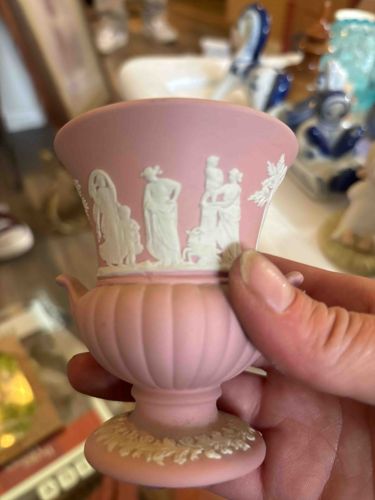
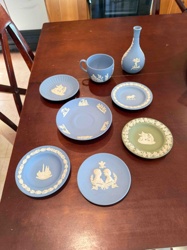
The item is a small, pink ceramic or stoneware vase or urn, characteristic of Wedgwood Jasperware. It exhibits a matte, unglazed finish in a delicate pastel pink hue, known in Wedgwood's palette as 'Rose Pink' or a similar shade. The vessel features intricately applied white bas-relief decorations, which stand out prominently against the pink ground. The upper cylindrical portion of the vase is adorned with classical figures in various poses, typical of Neoclassical themes found in Wedgwood designs since the late 18th century. These figures appear to be draped in flowing garments, reminiscent of ancient Greek or Roman mythology. Below this, the body of the vase transitions into a ribbed or gadrooned section, leading down to a footed base. The foot or pedestal is circular and is also embellished with white bas-relief patterns, possibly a delicate foliate or classical border design. The overall form suggests an urn or a small decorative pot, commonly used for flowers or as an ornamental accent. The craftsmanship appears to be of high quality, with fine detailing in the relief work. There are no immediately visible chips, cracks, or significant damage, suggesting it is in good to excellent vintage or antique condition, though a closer inspection for minor wear or staining would be necessary. The matte finish helps to highlight the sculptural details of the white figures. Given the style, material, and decorative motifs, this piece is likely from the late 19th to mid-20th century, consistent with Wedgwood's production of Jasperware.
AI Appraisal Report
I have carefully examined the provided image of this Wedgwood Rose Pink Jasperware Miniature Urn/Vase, noting its classic form and intricate bas-relief decoration. Visually, the condition appears to be good to excellent, with no apparent chips, cracks, or significant damage. The matte rose pink ground and crisp white applied figures suggest well-preserved surface quality. The stylistic elements, including the Neoclassical figures and gadrooned body, are entirely consistent with Wedgwood Jasperware production from the late 19th to mid-20th century. The 'Empire' reference by the owner further solidifies its likely period, as this style was popular during that era.
Authenticity, based purely on imagery, appears strong. However, a definitive authentication would necessitate a physical inspection to verify maker's marks, internal condition, and the tactile quality of the Jasperware. Provenance documentation, if available, would also be invaluable. Market conditions for Wedgwood Jasperware, particularly in desirable colors like rose pink, remain stable with consistent demand among collectors. While not exceedingly rare, miniature urns in excellent condition with detailed relief work are sought after. Factors impacting value positively include its appealing color, good condition, and classic decorative motifs. Conversely, any hidden damage, repairs, or an unusually late production date could slightly temper its value. Without a direct examination, I cannot definitively rule out very subtle flaws or determine the exact production date, which would provide the most precise valuation.