AI estimate as of July 19, 2025 · verify with a professional before acting
AI-Generated · Verify before acting
Everything on this page is generated by AI for informational purposes only. AI can make mistakes — the AI may misidentify items or misattribute them (artist, maker, brand, designer, origin, era). This is not an official valuation and should not be used for insurance, sale, tax, estate, legal, or lending purposes — or any decision requiring a certified appraisal. It is not an authoritative claim about any person, brand, or rights holder — do not share or rely on it as a factual statement about a third party. Always consult qualified professionals before making financial decisions.
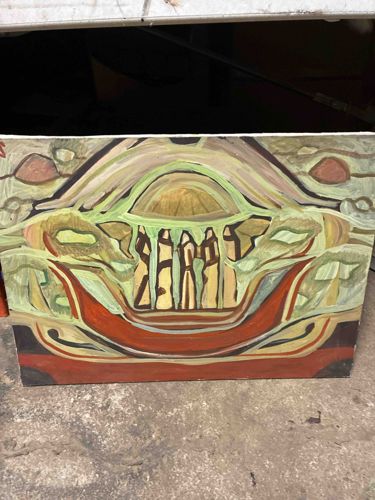
The item is an original painting, likely executed with oil or acrylic paints on a canvas or board substrate. It features a bold, somewhat abstract, and possibly allegorical scene. The color palette is dominated by earthy tones including various shades of green, brown, beige, and a prominent deep red. The central motif appears to be a stylized vessel, somewhat boat-like, in a striking red hue, occupying the lower half of the composition. Within this vessel, or perhaps standing behind it on what could be a platform, are several simplified, elongated figures, depicted in beige and brown tones. Above them, a large, rounded, arch-like structure, predominantly green, forms a canopy or an overarching landscape element. On either side of the central figures, there are what appear to be organic or architectural forms, also in green and brown. The overall style suggests a modern or mid-20th-century aesthetic, possibly influenced by Expressionism or folk art, given the flattened forms and strong outlines. The paint application appears to be somewhat thick, indicating visible brushstrokes. There is no visible frame surrounding the artwork in the image; it appears to be a loose canvas or board. The edges show some wear, typical of an unframed piece that has been stored. There are no obvious signs of significant damage like tears or major paint loss, but general surface dirt or handling marks might be present due to its unframed state and apparent storage conditions. No visible artist's signature, date, or specific manufacturing marks are discernible from the provided image.
AI Appraisal Report
Based on my visual examination of the provided image, I assess this Abstract Figurative Painting with Boat and Figures to be an original artwork, likely oil or acrylic on canvas or board, given the visible texture and application. The style, characterized by flattened forms, strong outlines, and a bold color palette of earthy tones with a prominent red, suggests a mid-20th-century aesthetic, possibly influenced by Expressionism or folk art. The condition appears fair; while there are no obvious tears or significant paint loss, the unframed state indicates potential surface dirt, handling marks, and edge wear. These are typical for an artwork stored without protection and contribute to a lower condition assessment than if it were professionally framed and preserved.
Market conditions for unsigned abstract figurative works vary significantly. While a distinctive style like this can generate interest, the lack of an identifiable artist or provenance greatly impacts its marketability and value. Comparables would include similar-sized unsigned mid-century abstract or folk art paintings, which typically fetch modest prices at auction or in secondary markets. Demand for such pieces is generally stable but not exceptional unless connected to a known movement or artist.
Factors significantly impacting value here are primarily the absence of an artist's signature and provenance. This limits its appeal to collectors seeking documented works. Without attribution, it functions more as a decorative piece than a fine art investment.
Limitations in authenticity verification from an image alone are substantial. I cannot definitively confirm the medium (oil vs. acrylic), the exact substrate, or the age. For full authentication, in-person examination would be required to analyze paint layers, pigment composition, and canvas/board characteristics. Provenance documentation (prior ownership history, exhibition records) would be crucial for establishing authorship and historical context. Scientific testing, such as pigment analysis or dendrochronology (if on wood), could further aid in dating and material verification.