AI estimate as of August 26, 2025 · verify with a professional before acting
AI-Generated · Verify before acting
Everything on this page is generated by AI for informational purposes only. AI can make mistakes — the AI may misidentify items or misattribute them (artist, maker, brand, designer, origin, era). This is not an official valuation and should not be used for insurance, sale, tax, estate, legal, or lending purposes — or any decision requiring a certified appraisal. It is not an authoritative claim about any person, brand, or rights holder — do not share or rely on it as a factual statement about a third party. Always consult qualified professionals before making financial decisions.
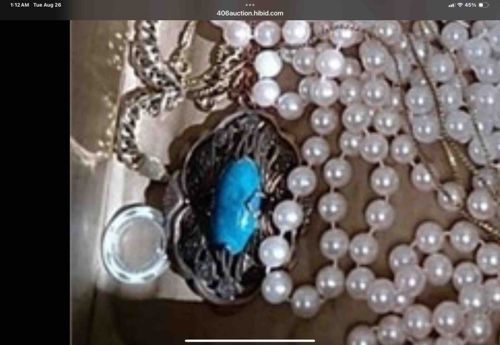
This item appears to be a collection of various jewelry pieces, predominantly featuring strands of simulated pearls and a notable pendant. The main focal point is a large, ornate pendant with a central, irregularly shaped cabochon of bright turquoise-colored material. The setting for this stone is dark, possibly oxidized sterling silver or pewter, featuring intricate scrollwork or filigree surrounding the turquoise. The design of the metalwork suggests a vintage or antique aesthetic, possibly in an Art Nouveau or Arts and Crafts style, though without clearer markings, an exact period is difficult to ascertain. The back of the pendant is not visible, so identifying manufacturing details like maker's marks is not possible. Connected to the pendant, or in close proximity, is a robust, possibly silver-toned chain (visible in the upper left of the image). A multitude of pearl strands dominate the right side of the image, appearing to be faux pearls due to their uniform size, shape, and luster. They are consistent in color, a classic creamy white, strung together. Some strands show a slightly higher luster than others, but overall, they present as costume jewelry. There are no visible chips, cracks, or significant abrasions on the pearls. The metal findings for the pearl strands are not visible, making it hard to assess their type or quality. The overall condition of the pieces appears good, with no obvious damage or missing components. The darkened patina on the pendant suggests age or intentional antiquing. This ensemble would likely be considered costume jewelry, possibly vintage, intended for decorative rather than intrinsic value based on precious materials.
AI Appraisal Report
I have examined the provided image of the 'Assorted Vintage-Style Costume Jewelry with Turquoise-Colored Pendant and Faux Pearl Strands.' Based on my visual assessment, the condition of the ensemble appears good, with no obvious chips, cracks, or significant damage to the faux pearls or the pendant. The turquoise-colored cabochon in the pendant seems well-set, and the dark metalwork exhibits an intentional antiqued look, consistent with its vintage-style presentation. I assess this collection as costume jewelry due to the uniform appearance of the pearls suggesting they are simulated, and the general aesthetic of the pendant, which, while ornate, does not immediately present as fine jewelry. Authenticity as genuine vintage rather than modern reproduction in a vintage style is difficult to ascertain from images alone; closer examination of construction, findings, and potential maker's marks would be crucial. The market for vintage costume jewelry is generally stable, with demand for unique, wearable pieces. This ensemble, with its distinctive pendant and classic faux pearls, has decorative appeal. Factors impacting value include the material of the pendant (e.g., if truly sterling silver vs. base metal), the quality of the faux pearls, and true age. Without knowing if the pendant is a true vintage piece or a reproduction, its rarity is difficult to determine. Limitations in authenticity verification are significant; in-person examination is necessary to check for hallmarks, assess the weight and feel of the materials, and verify the construction quality. Scientific testing would be needed to confirm the composition of the pendant metal and the pearls (e.g., shell-based vs. plastic). Provenance documentation, if available, would also greatly aid in authenticating its age and origin.