AI estimate as of July 29, 2025 · verify with a professional before acting
AI-Generated · Verify before acting
Everything on this page is generated by AI for informational purposes only. AI can make mistakes — the AI may misidentify items or misattribute them (artist, maker, brand, designer, origin, era). This is not an official valuation and should not be used for insurance, sale, tax, estate, legal, or lending purposes — or any decision requiring a certified appraisal. It is not an authoritative claim about any person, brand, or rights holder — do not share or rely on it as a factual statement about a third party. Always consult qualified professionals before making financial decisions.
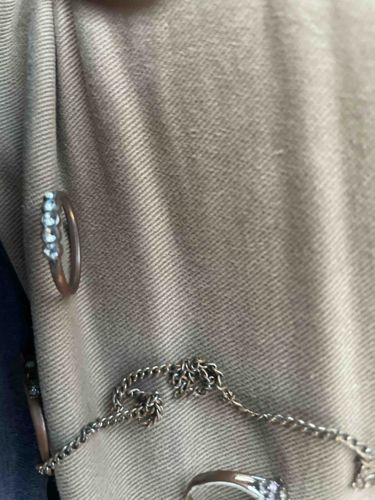
This ensemble appears to consist of multiple pieces of jewelry, including at least three rings and a chain, laid out on a light brown or beige fabric surface, possibly a garment or cloth. The fabric shows a prominent diagonal twill weave pattern and some minor pilling, suggesting it is a natural fiber or blend. The rings are varying in design. One ring, visible on the upper left, features what appear to be five small, round, brilliant-cut stones, possibly diamonds or a simulant like cubic zirconia, set in a band that has a reddish-gold hue, perhaps rose gold or a copper alloy. The stones are closely set, forming a line across the top of the band. Another ring, partially visible at the bottom right, also features multiple small, light-colored stones, but their arrangement or exact setting is less clear due to the angle and focus. There might be a third ring, only barely visible to the left, which also seems to have stones. The chain is a metallic, likely silver-toned, curb or flat link chain. It is tangled in the center, suggesting it may have been recently removed or is awaiting organization. The metal of the chain shows some surface oxidation or tarnish, contributing to a slightly darker, aged appearance. The overall condition of the items appears to be fair, with visible wear on the chain in the form of tarnish, and the rings showing slight surface wear consistent with regular use. No specific maker's marks or other identifying inscriptions are discernible from the provided image. The style of the rings is classic and could range from late 20th century to contemporary.
AI Appraisal Report
I have examined the provided image of the 'Assorted Rings and Chain' ensemble. Based on this visual assessment, the items appear to be mass-produced contemporary or late 20th-century jewelry. The rings, particularly the one with five small, round stones, suggest costume jewelry or low-value precious metals given the lack of discernible hallmarks and the generalized appearance of the stones. Without magnification or testing, I cannot verify if the stones are genuine diamonds or simulants, nor can I confirm the metal content (e.g., gold, silver, or plated base metal). The chain, appearing silver-toned with visible tarnish, is likely sterling silver, plated metal, or a base metal alloy; its curb/flat link style is common. The overall condition is fair, with expected wear and tarnish consistent with regular use for costume or everyday pieces.
In the current market, similar pre-owned costume or low-karat/plated jewelry pieces have limited resale value. Demand for such items is generally low unless they possess intrinsic value (high-quality gemstones, significant precious metal content) or designer provenance, neither of which is evident here. Rarity is not a factor; these styles are very common. Factors significantly impacting value are the unknown metal purity of the rings and chain, and the true identity of the stones.
Authenticity verification from images alone is severely limited. A full in-person examination would require: (1) Gemological testing of the stones to determine type, quality, and origin; (2) Metal purity testing (e.g., XRF analysis or acid testing) for all metallic components; (3) Close inspection for maker's marks or hallmarks, which are crucial for identifying manufacturers and verifying material claims. Without this physical inspection and testing, any value assigned remains highly speculative.