AI estimate as of October 9, 2025 · verify with a professional before acting
AI-Generated · Verify before acting
Everything on this page is generated by AI for informational purposes only. AI can make mistakes — the AI may misidentify items or misattribute them (artist, maker, brand, designer, origin, era). This is not an official valuation and should not be used for insurance, sale, tax, estate, legal, or lending purposes — or any decision requiring a certified appraisal. It is not an authoritative claim about any person, brand, or rights holder — do not share or rely on it as a factual statement about a third party. Always consult qualified professionals before making financial decisions.
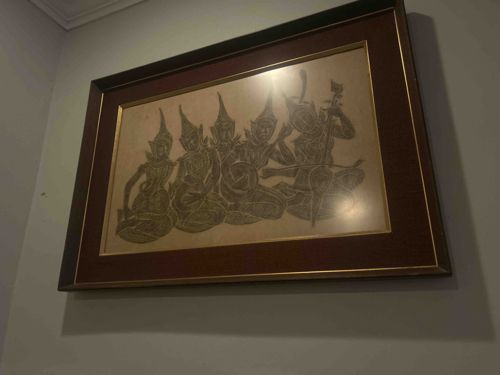
This item is a framed artwork depicting a traditional Southeast Asian musical ensemble. The artwork itself appears to be a relief or etching, possibly done on a metallic sheet (such as brass or copper) or a textured paper/board, which has then been patinated or treated to achieve a monochromatic, aged bronze or muted gold appearance against a slightly lighter background, possibly off-white or light tan. The figures, numbering at least five, are rendered in a distinct, stylized manner with intricate detailing on their attire and headwear, characteristic of traditional Southeast Asian art, particularly from countries like Thailand, Cambodia, or Laos. Each figure is seated, engaged in playing a musical instrument, including what appears to be stringed instruments, drums, and possibly others. The lines used to create the figures are fine and consistent, indicating skilled craftsmanship. The overall impression is one of cultural significance and artistic tradition. The artwork is housed within a dark wooden frame, possibly mahogany or a similar rich-toned wood, featuring a thin, inner gold-colored fillet that provides a subtle contrast and enhances the visual appeal. The artwork is protected by a clear pane, likely glass, which reflects some light sources in the image. Although the precise dimensions are not provided, it appears to be a medium-sized piece, suitable for wall display. No visible damage or major condition issues like cracks or significant wear are apparent in the artwork itself from the provided image, though specific surface details are obscured by reflections. The frame appears to be in good condition with no obvious chips or damage. The piece most likely dates from the mid to late 20th century, given its framing style, but could potentially be older if the artwork itself is a traditional craft piece. The quality indicators point to a well-executed piece of cultural art, presented in a classic framing style.
AI Appraisal Report
Based on my visual examination of the provided image, this framed artwork depicting a traditional Southeast Asian musical ensemble appears to be in very good condition. The medium, possibly a relief or etching on metallic sheet or textured board with a patinated finish, shows no apparent damage or significant wear, though reflections obscure some surface details. The stylistic rendering of the figures, their attire, and musical instruments is consistent with traditional Southeast Asian art from regions like Thailand or Cambodia, suggesting cultural authenticity in its design. The dark wooden frame with a gold-colored fillet is also in good condition, enhancing the artwork's presentation.
Market conditions for such decorative cultural art pieces are generally stable, with demand driven by interior decorators and collectors of global art. While the craftsmanship appears skilled, without further information, it's difficult to ascertain if this is a unique artisan piece or a mass-produced item. Similar framed Southeast Asian cultural art, especially if decorative rather than of significant artistic historical provenance, typically fetches prices in the low to mid-hundreds at auction or retail.
Key factors impacting value include its age (likely mid-to-late 20th century), the quality and originality of the relief/etching technique, and its overall aesthetic appeal. Rarity would increase significantly if this were identified as a piece by a known artist or from a historically significant workshop, which is not determinable from the image alone.
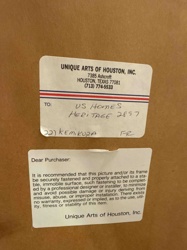
Authenticity verification from images alone is limited. A full authentication would require in-person examination to ascertain the exact medium and technique (e.g., actual metal vs. composite, hand-etched vs. molded), assess the patina for age and originality, and inspect for any maker's marks or signatures. Provenance documentation, detailing the artwork's history and origin, would also be crucial, as would scientific testing to confirm materials if warranted. Without these, the value remains conservatively estimated based on its decorative and cultural merits.