AI estimate as of June 23, 2025 · verify with a professional before acting
AI-Generated · Verify before acting
Everything on this page is generated by AI for informational purposes only. AI can make mistakes — the AI may misidentify items or misattribute them (artist, maker, brand, designer, origin, era). This is not an official valuation and should not be used for insurance, sale, tax, estate, legal, or lending purposes — or any decision requiring a certified appraisal. It is not an authoritative claim about any person, brand, or rights holder — do not share or rely on it as a factual statement about a third party. Always consult qualified professionals before making financial decisions.
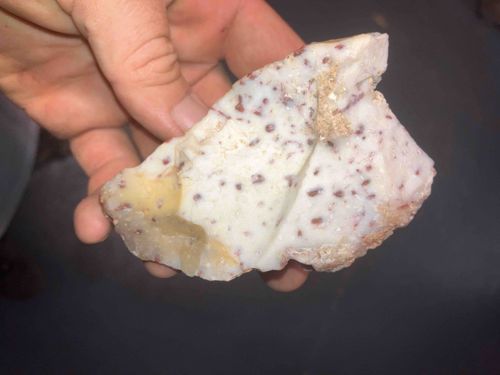
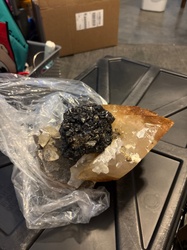
The item appears to be a raw, unpolished piece of natural stone or mineral, specifically resembling Rhyolite with visible red porphyritic inclusions, often referred to as 'Poppy Jasper' or similar patterned rhyolites. It is approximately palm-sized, judging by the hand holding it, suggesting dimensions of roughly 4-6 inches in its longest dimension. The primary color of the matrix is an off-white to creamy beige, with an overall opaque appearance. Scattered throughout this light-colored matrix are numerous small, irregularly shaped inclusions of a reddish-brown or burgundy hue, varying in size from pinprick dots to small lentils. These inclusions are unevenly distributed but give the stone a speckled or 'poppy seed' like pattern. The texture seems rugged and unrefined, characteristic of a natural fracture or cleavage plane. There are areas where a yellowish-tan material is present, possibly indicating a different mineral inclusion, weathering, or alteration. The edges are sharp and irregular, consistent with a freshly broken or naturally weathered surface rather than a cut or tumbled specimen. There are no discernible manufacturing marks, stamps, or significant craftsmanship details as it is a natural piece. Its estimated age is geological, given it is a rock formation. The visible condition is natural, with no obvious signs of damage beyond its inherent rough form. The quality indicators are in the clarity and color contrast of the inclusions against the matrix.
AI Appraisal Report
Based on my visual examination of the provided image, this Rhyolite (Poppy Jasper Type) Mineral Specimen appears to be an authentic, raw, unpolished piece. Its condition is consistent with a natural fracture, displaying good color contrast between the off-white matrix and the reddish-brown porphyritic inclusions, which are characteristic of "Poppy Jasper" or similar patterned rhyolites. The presence of yellowish-tan material suggests potential minor weathering or a different mineral presence, which is typical for such natural specimens and does not significantly detract from its aesthetic appeal or authenticity as a geological sample. As an appraiser, I note that while the visual evidence strongly supports authenticity, a full authentication would ideally involve in-person examination to verify texture, density, luster, and to rule out any artificial coloring or reconstruction. Microscopic analysis could confirm mineralogical composition. Provenance documentation, such as where it was collected, would also add to its verifiable history, though this is less critical for a common mineral specimen of this type.Market conditions for raw mineral specimens like this fall into a niche collector's market and decorative item category. While "Poppy Jasper" is popular, raw, unpolished pieces generally command lower prices than cut and polished cabochons or sculptural forms. Comparables in its size range (approximately palm-sized, 4-6 inches) from reputable online mineral dealers or rock and gem shows suggest similar unworked specimens can range from a few dollars to perhaps twenty dollars depending on the vibrancy of color and distinctness of pattern. This piece has a good pattern and color.Demand for such a piece is moderate, primarily from hobbyist collectors, lapidary enthusiasts, or those seeking natural decorative elements. It is not considered rare in the broader mineral market, though specimens with particularly striking patterns or colors are more desirable.The primary factors impacting value are the clarity and contrast of the "poppy" inclusions, its unpolished, natural state (which lowers value compared to finished goods), and its size. This specimen displays a decent pattern but is not extraordinary. Had it been polished or faceted, its value would be considerably higher.