AI estimate as of December 13, 2025 · verify with a professional before acting
AI-Generated · Verify before acting
Everything on this page is generated by AI for informational purposes only. AI can make mistakes — the AI may misidentify items or misattribute them (artist, maker, brand, designer, origin, era). This is not an official valuation and should not be used for insurance, sale, tax, estate, legal, or lending purposes — or any decision requiring a certified appraisal. It is not an authoritative claim about any person, brand, or rights holder — do not share or rely on it as a factual statement about a third party. Always consult qualified professionals before making financial decisions.
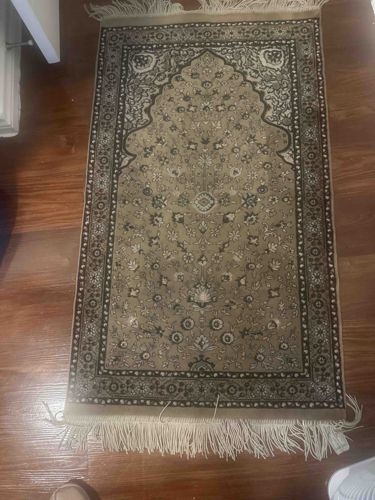
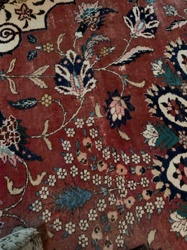
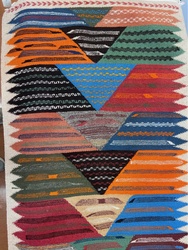
This item is a small, rectangular textile, appearing to be a traditional prayer rug. Its primary color palette consists of various shades of beige, tan, and brown, with accents of off-white or very light cream. The rug features a classic mihrab (prayer niche) design, centrally located, which is characteristic of prayer rugs. The mihrab's arch is outlined in a darker brown, contrasting with the lighter beige field, and is filled with intricate floral and foliate motifs in shades of brown, black, and light beige. The main field of the rug within the arch is densely populated with repeating patterns of stylized flowers, leaves, and possibly some geometric elements, also in complementary earthy tones. A prominent border frames the central design, consisting of multiple bands of varying widths, each adorned with its own distinct pattern. The outermost border appears to have a continuous vine or scroll motif interrupted by small circular or medallion-like elements. The edges of the rug are finished with short, off-white fringes, which show some slight disarray and minor fraying consistent with gentle use or handling. Physically, it appears to be a natural fiber, likely wool or a wool blend, given the appearance of the pile and the traditional style. The construction method is not definitively discernible from the image alone, but the uniformity of the design and clean lines suggest it could be machine-made, though a finely hand-knotted piece cannot be entirely ruled out without closer inspection of the knotting. The rug's condition appears generally good, with no obvious major damage, tears, or significant stains. The colors seem somewhat muted, which could indicate some age or simply be part of the intended aesthetic. The craftsmanship appears to be of good quality, with well-defined patterns and a tight weave, indicating durability. The estimated age would be contemporary or early to mid-20th century, depending on the manufacturing technique.
AI Appraisal Report
I have examined the provided image of this Traditional Floral Prayer Rug. Visually, the rug appears to be in good overall condition, with no obvious major damage, tears, or significant stains. The muted color palette of beiges, tans, and browns with off-white accents is consistent with traditional prayer rug aesthetics. The mihrab design with intricate floral and foliate motifs is a classic style.
From the image alone, I assess the item to be a natural fiber textile, likely wool or a wool blend. The uniformity of the patterns and clean lines suggest it may be machine-made, which is common for contemporary prayer rugs. While a finely hand-knotted piece cannot be entirely ruled out without close physical inspection, the visual cues lean towards machine construction, particularly at this potential price point. The fringed edges show minor wear consistent with use.
Market conditions for prayer rugs of this apparent quality and common design are generally stable but not highly lucrative. There is a consistent demand for functional and decorative prayer rugs, but the market is saturated with both machine-made and hand-knotted examples. Authentic, older hand-knotted pieces command higher values. Comparables for similar machine-made or less intricately hand-knotted prayer rugs in good condition typically fall within the $50-$200 range.
The primary factor impacting value here is the probable manufacturing method. If it were definitively hand-knotted with fine detail and natural dyes, its value would significantly increase. However, based on the image, its general market appeal is as a decorative and functional item rather than a collectible antique.
It is crucial to note that authentication limitations exist when relying solely on images. To definitively determine authenticity, materials, and construction method (hand-knotted vs. machine-made), I would require an in-person examination. This would involve inspecting knot density, warp and weft materials, dye analysis, and overall textile feel. Provenance documentation could also greatly assist in determining age and origin. Without physical inspection, I estimate its value in the range of $75 to $150, assuming it is a well-made contemporary or early to mid-20th century piece.